


EITI in Ukraine and worldwide
Extractive Industries Transparency Initiative (EITI).
EITI is an international standard that promotes the transparency of the country's extractive industries and provides for the disclosure of information about the state of affairs in the state's extractive sector. The purpose of implementing EIA in Ukraine is to ensure transparency in the management of the country's natural resources and disclosure of information about state revenues from the extractive sector. Currently, 55 countries of the world are implementing the EIA Standard. You can learn more about the EITI countries on the Initiative's international website.
Ukraine joined the Extractive Industries Transparency Initiative in 2013 and has been publishing annual EITI Reports since 2015, providing information on the number of companies operating in the extractive industries, the payments they make in favour of the state, and the extent to which companies participate in EITI reporting and disclosure.
To prepare these reports and carry out the reconciliation of payments in favour of the state made by companies engaged in the extraction of natural resources, the country appoints an Independent Administrator – an independent company with relevant expertise and experience. Six EITI Reports of Ukraine have already been published, which analyze the extractive industry of Ukraine for the years 2013-2019.
The Ministry of Energy of Ukraine is responsible for the implementation of the Initiative for the Transparency of Extractive Industries in Ukraine in accordance with the Law of Ukraine "On ensuring transparency in extractive industries".
.
Filter map
The EITI Reports for 2022–2024 cover information on business entities, regardless of their form of ownership, that carried out activities related to the extraction of mineral resources and the transportation of oil and natural gas across the territory of Ukraine, as well as on executive authorities that received payments from companies operating in the extractive industries.
| EITI Reports | Year of report publication | Scope of the report | Total payment volume of all companies in significant sectors | Of which, material payments made by material companies (subject to reconciliation) | Reconciliation coverage |
|---|---|---|---|---|---|
| Ukraine EITI Report for 2013 | 2015 | Natural gas and oil extraction Natural gas and oil transportation | UAH 26.8 billion | No reconciliation by payments and companies was carried out | No reconciliation by payments and companies was carried out |
| Ukraine EITI Report for 2014-2015 | 2017 | + Coal mining Iron ore mining Titanium ore mining Manganese ore mining | UAH 58.0 billion – 2014, UAH 92.5 billion – 2015 | UAH 55.6 bn - 95.8% of total, UAH 88.4 bn - 95.5% of total | 2014 - 81.5%, 2015 - 82.8% |
| Ukraine EITI Report for 2016 | 2018 | + Refractory clay mining Fire clay mining Quartz sand mining | UAH 105.0 billion | UAH 100.1 bn - (95.4% of total) | 91.8% |
| Ukraine EITI Report for 2017 | 2020 | + Construction stone extraction | UAH 145.4 billion | UAH 140.6 bn - (96.7% of total) | 98.4% |
| Ukraine EITI Report for 2018 | 2021 | 10 sectors (unchanged compared to the previous year) | UAH 187.9 billion | UAH 183.4 bn - (97.6% of total) | 99.06% |
| Ukraine EITI Report for 2019 | 2020 | 10 sectors (unchanged compared to the previous year) | UAH 165.4 billion | UAH 161.1 bn - (97.4% of total) | 99.06% |
| Ukraine EITI Report for 2020 | 2021 | 10 sectors (unchanged compared to the previous year) | UAH 186.7 billion | UAH 182.9 bn - (98.0% of total) | 100% |
| Ukraine EITI Report for 2021 | 2022 | 10 sectors (unchanged compared to the previous year) | UAH 216.6 billion | UAH 211.5 bn - (97.6% of total) | Reconciliation by payment and by company was not performed |
| Ukraine EITI Report for 2022 | 2023 | + Uranium ore mining | UAH 188.4 billion | UAH 185.4 bn - (98.4% of total) | 94.55% |
| Ukraine EITI Report for 2023 | 2024 | 11 sectors (unchanged compared to the previous year) | UAH 150.6 billion | UAH 147.2 bn - (97.7% of total) | 98.67% |
| Ukraine EITI Report for 2024 | 2025 | 11 sectors (unchanged compared to the previous year) | UAH 172.2 billion | UAH 169 bn - (98.1% of total) | 98.22 |
According to the decisions of the Ukraine EITI MSG (Minutes of the MSG meetings dated August 26, 2025; Minutes of the MSG meetings dated May 24, 2024; and Minutes of the MSG meetings dated October 27, 2023), in the EITI Reports for 2022–2024, reconciliation of payments in favour of the state covered only reporting companies operating in the sectors of hard coal extraction, oil and natural gas extraction (including oil and natural gas transportation), iron ore mining, titanium ore mining, and manganese ore mining.
In accordance with the Terms of Reference for the Independent Administrator and the decision of the Ukraine EITI MSG (Minutes of the MSG meetings dated December 7, 2022), the reconciliation of payments in favour of the state and the investigation of identified discrepancies were not conducted for the EITI Report 2021.
According to the decisions of the Ukraine MSG (Minutes of the MSG meetings dated October 1, 2021) in the EITI Report 2020, reconciliation of payments in favour of the state covered only companies operating in the sectors of hard coal extraction, oil and natural gas extraction (including oil and natural gas transportation), iron ore mining, titanium ore mining, and manganese ore mining.
Ukraine Validation
Validation is an independent assessment process used by the EITI Board to evaluate a country's implementation of the EITI Standard and determine the level of compliance with its requirements, as well as the achieved progress.
Ukraine 1st Validation
Following the first Validation of Ukraine under the EITI, the EITI Board, through Decision No.2018-37 dated 29 June 2018, determined that Ukraine had made meaningful progress in implementing the 2016 EITI Standard. The Board recognized Ukraine’s substantial achievements in enhancing transparency in the extractive sector, expanding EITI reporting to additional extractive industries, ensuring regular disclosure of government revenues and company payments, and supporting broader legislative and institutional reforms, including the adoption of the Law of Ukraine “On Ensuring Transparency in Extractive Industries".
At the same time, the EITI Board identified a number of corrective actions that Ukraine was required to implement before the next Validation. In particular, the Board recommended strengthening disclosures on the operations and financial relationships of state-owned enterprises, including information on state participation, state guarantees and loans, improving the quality and comprehensiveness of disclosed data, and continuing the transition towards systematic disclosure through government information systems. Particular emphasis was also placed on further advancing contract transparency and project-level reporting practices in the extractive sector.
Ukraine 2nd Validation
Following the second Validation of Ukraine, completed in 2021, the EITI Board, through Decision No.2021-22/BC-305 dated 30 March 2021, concluded that Ukraine had maintained its status of “meaningful progress” in implementing the EITI Standard while demonstrating significant improvements compared to the first Validation. The Board noted that Ukraine had fully addressed three of the eight corrective actions identified during the first Validation and had made substantial progress in enhancing transparency in the extractive sector. This included the digitalisation of special permit processes, expanded disclosure of beneficial ownership information, the development of electronic data collection systems (UAEITI Portal), and the gradual transition towards systematic disclosure through government information systems. The Board also highlighted the adoption of the Law of Ukraine “On Ensuring Transparency in Extractive Industries”, improvements to the sector’s regulatory framework, and the use of EITI mechanisms to support anti-corruption reforms and improve the investment climate.
At the same time, the EITI Board concluded that a number of the EITI Standard’s requirements were still not being fully met. To address the identified shortcomings, the Board established five corrective actions for Ukraine to implement before the next Validation. These actions included ensuring comprehensive disclosure of financial relationships between the state and state-owned enterprises, including loans and state guarantees; publishing complete data on the volumes and value of production for all mineral commodities; improving the assessment of materiality and the comprehensiveness of reporting coverage; ensuring adequate disclosure of revenues from the transportation of extractive resources with an appropriate level of disaggregation; and providing complete and reliable information on material transactions between state-owned enterprises, government entities and extractive companies. Ukraine was required to implement these corrective actions by 1 April 2023.
Thus, the second Validation confirmed Ukraine’s sustained progress in implementing the EITI Standard and demonstrated a significant improvement in the quality of disclosures compared to the first Validation. However, it identified several priority areas requiring further improvement, particularly with regard to the transparency of state participation and the completeness of data disclosure.
Ukraine 3rd Validation
On 18 June 2025, the EITI Board adopted a decision on the outcome of Ukraine’s Validation. Ukraine has achieved a score of 85.5 points (high) in implementing the EITI Standard 2019.
The overall score reflects an average of the three component scores on Stakeholder engagement, Transparency, and Outcomes and impact.
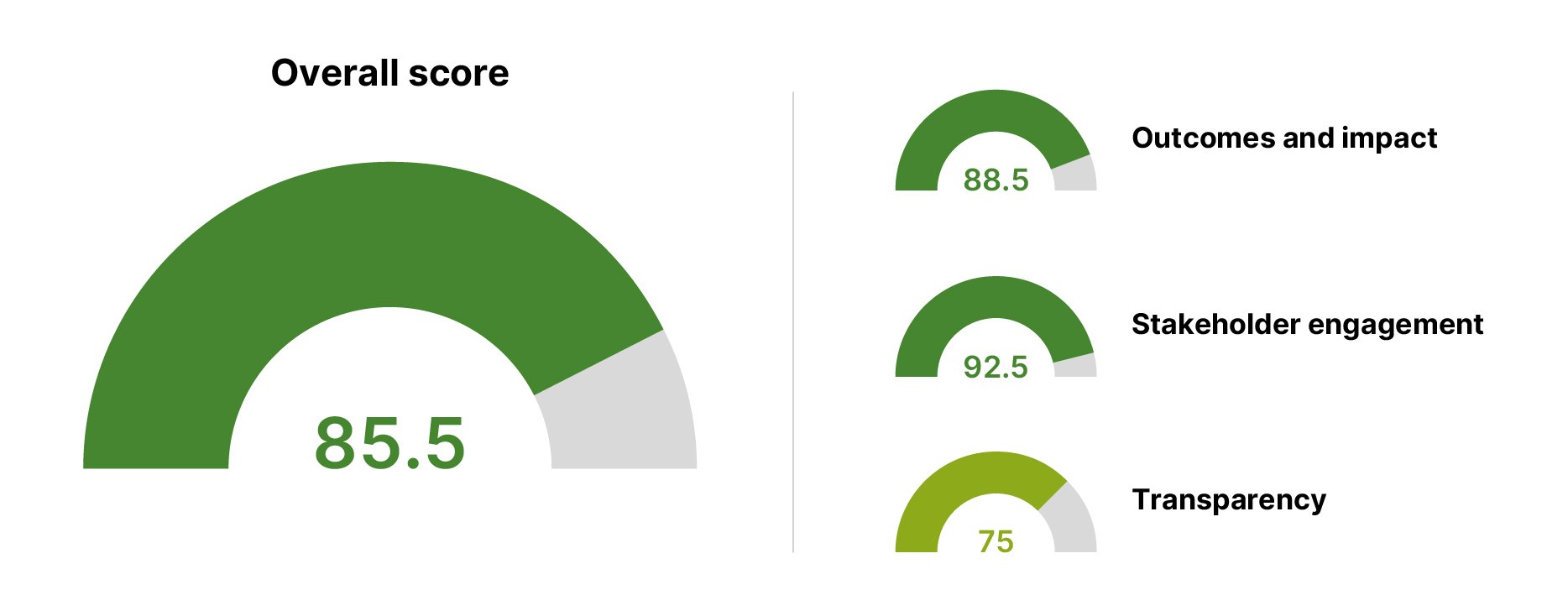 Results of Ukraine 3rd Validation
Outcomes and impact: for this component, a score of 88.5 points was achieved. The implementation of the EITI in Ukraine demonstrates significant achievements in meeting its objectives in line with changing national priorities and promoting transparency.
Stakeholder engagement: 92.5 points were scored. The EITI Board highly appreciated the active participation of all stakeholder groups in the EITI process under martial law.
Transparency: This component was assessed at 75 points. Since the last validation in 2020, the scope of the report has been significantly expanded and information on the extractive industry has been detailed, including revenue distribution, environmental information, and assessment of information on beneficial owners, etc.
At the same time, the EITI Board acknowledged the exceptional circumstances under which Ukraine continued to implement the EITI Standard following the onset of russia’s full-scale invasion in 2022. The Board positively assessed the ability of the Ukraine EITI MSG to ensure the continuity of the EITI process, maintain regular disclosures, and publish the 2021, 2022 and 2023 EITI Reports under martial law. The Board also welcomed the gradual restoration of disclosures of certain previously restricted data where this did not pose a risk to the security of strategic assets in the extractive sector.
The Validation also identified a number of areas requiring further improvement. Overall, the results of the third Validation confirmed Ukraine’s high level of implementation of the EITI Standard and the resilience of the extractive sector transparency framework under wartime conditions. The EITI Board identified priority areas for further development, including the restoration of comprehensive disclosures, the expansion of open data practices, and enhanced transparency of state participation in the extractive industries.
Guidance and recommendations
Information on laws and regulations concerning reporting templates/forms
Law of Ukraine "On ensuring transparency in the extractive industries"
Resolution of the Cabinet of Ministers of Ukraine dated September 23, 2020 No. 858 "Some issues of ensuring transparency in extractive industries"
Guidance materials with Templates and Video tutorials (How to submit the electronic form)
EITI Standard
Reporting forms/ templates
Data analysis and visualization
Knowledge base
Glossary
| Term | Meaning |
|---|---|
| EITI Report | A report containing the main results of implementation of procedures within the framework of the EITI implementation at the country level for the year. |
| EITI | The Extractive Industries Transparency Initiative is a voluntary association of states created to develop principles and requirements to ensure transparency in the extraction of oil, gas, and other minerals, in which representatives of governments, as well as enterprises operating in the extractive industries, and non-governmental organizations participate from the states. |
| EITI International Secretariat | The independent body responsible for the EITI implementation and management at the international level. Based in Oslo, Norway. |
| EITI MSG | The EITI Multi-Stakeholder Group is a multi-stakeholder group consisting of representatives of the government, extractive companies, and civil society organizations, established to monitor the EITI implementation process in Ukraine and inform about the findings of the EITI Report, as well as to integrate the EITI into broader activities to promote the extractive industries transparency. |
| Independent administrator | A business entity that reviews, analyses and reconciles information provided by businesses operating in extractive industries and recipients of payments, and provides services for preparing an EITI report in accordance with the Terms of Reference. |
| Reporting organizations | Extractive companies, state-owned enterprises, institutions and organizations, government agencies that provide reporting data for further processing and inclusion to the EITI Report |
| UAEITI Portal | Electronic reporting and analysis system for the Extractive Industries Transparency Initiative (EITI) in Ukraine: https://eiti.gov.ua/ |
| Material reporting companies | Companies in the extractive industries and the oil and natural gas transportation industry whose payments in favour of the state are determined to be material and subject to payment reconciliation |
| Material reporting sectors | Extractive industries as well as oil and natural gas transportation industry, payments from which in favour of the state are determined to be material and subject to payment reconciliation |
| EITI Standard | International standard for promoting transparency in managing a country's natural resources within the EITI. |
| Special permit | Special permit for subsoil use |
| Material types of payments | Types of tax and other budget revenues (as well as Unified Contribution), for which the payments from extractive industries are determined to be material and subject to payment reconciliation |
| Royalty for transportation | Rent payment for the transportation of oil and petroleum products through the main oil pipelines and petroleum product pipelines through the territory of Ukraine, transit transportation of natural gas and ammonia through the pipelines through the territory of Ukraine |
| SGS | State Service of Geology and Subsoil of Ukraine |
| State Labor Service | State Labor Service of Ukraine formed as a result of the reorganization of the State Mining Supervision Service of Ukraine and the State Labor Inspectorate of Ukraine |
| SSS, State Statistics Service | State Statistics Service of Ukraine |
| SCMR | State Commission of Ukraine for Mineral Resources |
| SCS | State Customs Service of Ukraine |
| STS | State Tax Service of Ukraine |
| State Treasury | State Treasury Service of Ukraine |
| CMU | Cabinet of Ministers of Ukraine |
| Ministry of Economy | Ministry of Economy, Environment, and Agriculture of Ukraine |
| Ministry of Energy | Ministry of Energy of Ukraine |
| Ministry of Finance | Ministry of Finance of Ukraine |
| NBU | National Bank of Ukraine |
| NCREPU | National Commission for State Regulation of Energy and Public Utilities |
| PFU | Pensions Fund of Ukraine |
| JVA | Joint venture agreement |
| USR | Unified State Register of Legal Entities, Individual Entrepreneurs and Public Organizations |
| PSA | Production Sharing Agreement |
Legal framework
- 1.
- 2.
- 3.
- 4.
-
5.
Law of Ukraine “On Ensuring Transparency in Extractive Industries”
-
6.
Law of Ukraine “On Production sharing agreements”
-
7.
Law of Ukraine “On Oil and Gas”
-
8.
Resolution of the Cabinet of Ministers of Ukraine “On approval of the procedure for maintaining the State Register of special permits for subsoil use”
-
9.
Resolution of the Cabinet of Ministers of Ukraine “On approval of the procedure for conducting auctions for the sale of special Permits for subsoil use”
-
10.
Resolution of the Cabinet of Ministers of Ukraine “Certain іssues of ensuring transparency in Extractive Industries”
-
11.
Resolution of the Cabinet of Ministers of Ukraine "On approval of the procedure for conducting state financial audits of business entities by the State Audit Service of Ukraine and its interregional territorial offices"
Ukraine national EITI reports