


Mining sector management
Loading...
Beneficiaries
Beneficiaries
Loading...

According to requirement 2.5.f of the EITI Standard, the beneficial owner of a company is a natural person who directly or indirectly owns or exercises control over a legal entity.
Ukrainian legislation defines that the ultimate beneficial owner (hereinafter -"beneficial owner") is:
-
►
for legal entities, any individual who exercises decisive influence (directly or indirectly) on the activities of the legal entity (including through the control/ ownership chain);
-
►
for trusts established in accordance with the laws of the country of their incorporation, the founder, trustee, protector (if any), beneficiary or group of beneficiaries, as well as any other natural person exercising decisive influence (directly or indirectly) on the activities of the trust (including through the control/ ownership chain);
-
►
for other similar legal entities – the person having the status equivalent or similar to the persons specified for trusts..
The indicators of an individual`s direct decisive influence on the activities of a legal entity is direct ownership of at least 25 per cent of the authorised (share) capital or voting rights of a legal entity. For indirect decisive influence, the same percentage of indirect ownership or exercise of decisive influence in another way
An individual who has a formal right to 25 per cent or more of the share capital or voting rights in a legal entity and acts as a commercial agent, nominee owner or nominee holder, or merely as an intermediary with respect to such right, is not a beneficial owner.
The concept of beneficial owner used for the preparation of EITI reports in the sense provided for by the Law on the Prevention and Counteraction of Legalization (Laundering) of Income.

Ukraine is one of the countries where there is an obligation to disclose information about the beneficial owners of all legal entities during state registration of their creation / changes to information about them in accordance with the Law of Ukraine "On State Registration of Legal Entities, Individuals - Entrepreneurs and Public Organizations".
Such information is included in the Unified State Register of Legal Entities, Individual Entrepreneurs and Public Organisations (hereinafter – the “USR”) and must be available online on the official website of the Ministry of Justice and the Unified State Open Data Portal. The same resources contain public information on the members (founders) of all legal entities registered in Ukraine, the amount of the authorised capital of such legal entities and the percentage of shares in the authorised capital owned by their members (founders).
Since March 2022, in connection with russia's military aggression against Ukraine, public access to USR and the possibility to make changes in the normal mode in order to protect the register information from unauthorized actions have been limited.
At the same time, even during this period, access remained possible to the USR on the basis of service contracts in the form of an application program interface (API) concluded with SE "NAIS", which is the technical administrator of the Unified and State Registers.
From December 26, 2022, access to the USR was restored. Information from the USR in electronic form is provided on the condition that the person who wishes to receive such information is identified using the means of a qualified electronic signature.
From May 2023, an applicant identified using a qualified electronic signature can access the information of the Register in electronic form through the portal of electronic services, Portal Diya, as well as using the service in the form of a USR application software interface on the basis of a contract concluded with the technical administrator of this registry.

The information published in the USR does not always fully meet the requirements of the Standard. For example, the information on the country of citizenship, date of birth, place of residence, nature and share of ownership is not always complete, including for technical reasons (e.g. due to heterogeneity and differences in the rules for storing information in the database during different periods of the USR operations).
In addition, the current legislation does not require the disclosure of beneficial ownership information in the USR for representative offices of non-resident entities, Joint Venture Agreements, or Production Sharing Agreements .
Measures aimed at updating information about beneficial owners
In 2022, there was a rule according to which legal entities registered before July 2021 had to submit documents to the state registrar within a year to update information about the beneficial owner in the USR.
Also in July 2022, it was supposed to enter into force requirement for annual confirmation of information about the final beneficial owner. However, due to the introduction of martial law, the updating and annual confirmation of beneficial owner information was postponed, and from December 29, 2022, the obligation to annually confirm information was abolished.
Instead, it was established that legal entities must submit updated information about the ultimate beneficial owner within six months from the date of recruitment. legal acts, which will approve the provisions on the form and content of the ownership structure and the methodology for determining the ultimate beneficial owner by a legal entity, but not earlier than 90 days after the termination or cancellation of martial law in Ukraine.
The form and content of the ownership structure, approved in 2021, provides a schematic representation of the ownership structure of a legal entity, which reflects all persons who directly or indirectly own this person independently or jointly with other persons or regardless of formal ownership have the possibility of significant influence on the management or activity of the legal entity. Samples of drawing up a schematic image of the ownership structure can be found on the official website of the Ministry of Finance of Ukraine under the heading "Financial Monitoring". 6 months from the date of entry into force of the Methodology (October 3, 2023), but no earlier than 90 days from the date of termination or cancellation of martial law in Ukraine.
Verification of information about beneficial owners
On December 29, 2022, the Law of Ukraine "On Amendments to Certain Laws of Ukraine on Improving the Regulation of Ultimate Beneficial Ownership and Ownership Structure of Legal Entities" No. 2571-IX entered into force. The specified law was adopted with the aim of simplifying the submission of information about beneficial owners and ownership structure by legal entities entered in the USR and ensuring the entry of reliable data about beneficial owners into the register.
Measures regarding disclosure of beneficial owners of non-resident representative offices
In 2022, the legislation did not provide for the inclusion of information on the ultimate beneficial owners of non-residents who have representative offices in Ukraine in the USR.
In 2022 and 2023, a number of amendments to regulatory acts aimed at eliminating this deficiency were adopted.
-
►
In 2022, the public disclosure of information on the ultimate beneficial owner in the Unified State Register became a prerequisite for obtaining a special permit for subsoil use. However, this requirement did not take into account that information on representative offices of non-resident entities is not recorded in the Unified State Register.
-
►
At the end of 2022, amendments to the Tax Code of Ukraine introduced an obligation for non-residents operating through permanent establishments in Ukraine to disclose their ownership structure and ultimate beneficial owners. However, this requirement will become effective from the tax period beginning on 1 January of the year following the year in which martial law is terminated or cancelled.
-
►
In 2023, amendments were also introduced to the state registration rules requiring the disclosure of the ownership structure and ultimate beneficial owners of a foreign legal entity establishing a separate subdivision in Ukraine, as well as the inclusion of such information in the Unified State Register. However, these provisions will enter into force in September 2024.
In addition, the requirement to enter information about representative offices that were registered before the introduction of the relevant rule into the USR is not addressed. Also, the specified changes do not address the disclosure of beneficial owners of non-resident members of the JVAs, who may not have permanent representation on the territory of Ukraine.
Disclosure measures regarding politically influential persons
In Ukraine, there are non-state sources of information about the status of influential political figures. For example, the Open Register of National Public Figures of Ukraine, launched by the NGO "Anti-corruption Center". However, in 2022, access to the registry was closed due to martial law.

In 2017, Ukraine took an important step towards increasing transparency – it joined the Global Register of Beneficial Owners and became the first country to officially declare its readiness to provide data on beneficial owners for the register.
In order to establish and develop cooperation in providing information to the register, the Ministry of Justice, the State Agency for of e-governance, Transparency International Ukraine and the OpenOwnership consortium signed a Memorandum of Understanding. The CMU also made amendments to the by-laws that provide for the free transfer of information on beneficial owners to the Global Register of Beneficial Owners.
Information on the beneficial owners of Ukrainian companies contained in the UDR is already partially available in the Global Register of Beneficial Owners, but for correct display and search it will be necessary integration Further transformation of data to achieve full compliance with the Beneficial Ownership Data Standard is identified among the next steps under the Open Government Partnership Initiative in 2020-2021. However, this step has not yet been implemented.

Information about civil servants who are beneficial owners (controllers) of legal entities was available in the Unified State Register of Declarations of Persons Authorized to Perform the Functions of the State or Local Self-Government.
In 2022, the procedure for forming, maintaining and publication (provision) of information from the Unified State Register of Declarations of Persons Authorized to Perform State or Local Self-Government Functions. At the same time, in connection with the introduction of martial law on the territory of Ukraine in 2022, the deadline for submitting declarations was extended. Natural persons received the right to submit declarations within three months after the termination or cancellation of martial law or the state of war, which caused incomplete information in the register for 2022.
In September 2023, a law was adopted that restored electronic declaration and open access (taking into account security measures) to the register of declarations of persons, authorized to perform the functions of the state or local self-government. The law requires persons who in 2022-2023 did not submit a declaration of a person authorized to perform the functions of the state or local self-government to submit such declarations no later than January 31, 2024. occupied territories or where active hostilities are taking place, those who are being treated as a result of injury, etc., as well as family members of the specified persons) the obligation to submit declarations is postponed - no later than 90 days after the change of the conditions that grant the right to postponement.
At the beginning of December 2023, the National Agency on Corruption Prevention opened access to the Unified State Register of Declarations persons authorized to perform functions of the state or local self-government.

Information about owners of 5 percent or more of shares in joint-stock companies is available in the database of issuers posted on the website of the Agency for the Development of the Infrastructure of the Stock Market of Ukraine at the link http://smida.gov.ua/db/emitent. The specified database contains, among other things, information about the stock exchanges on which the shares of all issuers registered in Ukraine are placed.
On 13.05.2022, the NCCPFR suspended the license for the organization of trading products on commodity exchanges of PJSC "Ukrainian Interbank Currency Exchange" until the expiration date martial law As of the date of preparation of this Report, PJSC "Ukrainian Interbank Currency Exchange" has been excluded from the Register, and licenses to conduct activities on the capital markets have been canceled. At the same time, shares of only a small part of Ukrainian issuers are listed on stock exchanges. Among the accountable companies there are only two such companies:
-
►
Ukrnafta PJSC – unlisted securities in the stock exchange list of Stock Exchange PFTS JSC and Stock Exchange “Perspective” PJSC
-
►
ArcelorMittal Kryvyi Rih PJSC – on 27.09.2023, its unlisted securities were excluded from the stock exchange list of Ukrainian Exchange JSC
DATA OF REPORTS OF BUSINESS ENTITIES
| Year | Company name | USREOU Code | Available | The reason for the absence of KBV | Full name of the legal entity through which indirect influence is exercised | Full name of the legal entity through which indirect influence is exercised | Surname, first name, patronymic *filled in reports until 2024. |
Name | Name, patronymic (if available) | Country of citizenship | Type of relationship to PZO | Type of PZO | Surname PZO | Name and patronymic (if available) PZO | The currency of the contribution to the authorized capital | Authorized capital, thousand | Type of beneficial ownership | Direct impact, % | Indirect impact, % | The nature and extent of influence is different |
|---|
Agreements, licenses, permits
Map of special permits as of 2021
Note: The data displayed on the map is current as of 2021.
Register of special permits for subsoil use
Access to data on holders of special permits can be obtained online on the website of the Geoinform Ukrainy DNEP at the following link: http://geoinf.kiev.ua/specdozvoli/*.
*The information manager has stopped publishing data for the period of martial law.
The search system allows you to search for valid, invalid and temporarily suspended permits.
The following information is available in the system:
- the owner of the permit;
- information about the site subsoil provided for use (location, geographical coordinates, area, number of reserves on the date of issuance of the permit, degree of subsoil development, information on testing of reserves);
- registration number of the permit;
- date of issuance, duration and validity of the permit;
- type of useful minerals;
- basis for granting permission;
- type of use of subsoil, purpose of use of subsoil;
- special conditions of permission;
- requisites of agreement on conditions of use of subsoil area;
- the source of funding;
- the amount of the fee paid for the granting of a special permit.
As of the date of this Report, the register of special permits for subsoil use contains information on 136 special permits issued during 2020, all of which are valid.
Scanned copies of all these permits, together with agreements on the conditions of subsoil use (including work programs) are published on the website of the State Geonadra under the link: https://www.geo.gov.ua/nadrokorystuvannya/vydani-speczdozvoly-ta-ugody/*.
*The information manager stopped publishing data for the period of martial law.
Information about special permits from the above register is published or integrated into the following government resources:
State geological portal
In September 2021, information on special permits for the use of subsoil was posted on the State Geological Portal:
1) in the form of an interactive map, which outlines the contours of special permits for the use of subsoil in each of the regions of Ukraine, via the link: https://nadra.gov.ua/.
2) in the format available for further processing (.xlsx), as well as other formats (kmz, json) at the link: https://nadra.gov.ua/site/opendata*.
*The information manager has stopped publishing data for the period of martial law.
Public cadastral map
As part of the integration of state cadastres, in October 2019, a "Geonadra" layer with information on issued permits for the use of subsoil was applied to the Public Cadastre Map, to which access is provided by DNVP "Geoinform of Ukraine", at the link: http://newmap.land.gov.ua*.
*The information manager stopped publishing data for the period of martial law.
Database of special permits for the use of subsoil on the Unified state web portal of open data
In 2019, the Database of Special Subsoil Use Permits was created on the Unified State Open Data Web Portal, which is subject to annual updates. Data are displayed in .xls format files separately for water and all other types of minerals.
The databases include, in particular, information about the owner, the state of subsoil use, the type of mineral, the industry in which the mined mineral is used, the name of the subsoil area provided for use, the registration number of the permit, the date of its issuance, the duration and validity of the permit. As of the date of this Report, information on special permits is partially reflected in these databases.
Legislation on publication of contracts in extractive industries
According to the Procedure for Granting Special Permits, the State Geosoil Service is required to publish, together with issued special permits, the corresponding agreements on the conditions of subsoil use, which are an integral part of such special permits.
The Law of Ukraine "On the Open Use of Public Funds" requires mandatory disclosure by managers and recipients of state and local funds budgets, state and communally owned business entities, information about the contracts concluded during the reporting period. At the same time, the amount of information made public does not include the text of the contracts.
The Law on EITI provides for mandatory disclosure to the Ministry of Energy of "material" conditions and extracts from agreements related to the extraction of minerals, namely: agreements on the conditions of subsoil use, URP, DSD and other contracts, on the basis of which project activities are carried out, within 1 month from the date of receipt relevant information from business entities. Business entities have 1 month from the date of conclusion of such agreements to transfer information to the Ministry of Energy.
At the same time, the Law on EITI does not set clear requirements for the publication of information regarding agreements concluded/amended before the law enters into force (that is, until November 16, 2018).
Agreement on the conditions of subsoil use
The main contractual document that defines the conditions of subsoil use is the agreement on the conditions of subsoil use.
The specified agreement is concluded between the State Geosoil Department and the holder of a special permit for the use of subsoil, and according to the Procedure for granting special permits, the Temporary Order and the Oil and Gas Law, it is integral to it part.
The agreement must contain conditions on the technical, technological, organizational, financial, economic, social, and environmental obligations of the parties and on the procedure for regulating relations between them in the process of subsoil use on the given subsoil area.
The specified agreement also contains a work program, which is drawn up as an appendix, and special conditions for the use of subsoil, which provide for:
1) requirements for work efficiency;
2) modern technologies of mineral extraction and processing;
3) the procedure for extracting minerals, in particular with the aim of preventing negative environmental consequences and ensuring the safety of built-up areas;
4) types, volumes and terms of work on the subsoil area;
5) grounds for termination of activity, related to the use of a subsoil area.
Additional conditions may be established in accordance with the legislation in the agreement on the conditions of use of an area of oil and gas-bearing subsoil located within the continental shelf or the exclusive (marine) economic zone of Ukraine concluded between the State Geosoil and the subsoil user.
Sample agreements on the conditions of subsoil use are approved by the order of the State Geodesy and posted on their official website at the link http://www.geo.gov.ua/primirni-ugodi-pro-umovi-koristuvannya-nadrami/.
Scanned copies of 136 special permits and corresponding agreements on the conditions for the use of subsoils are posted on the official website of the State Geodesy, which corresponds to the information in the register of special permits for the use of subsoils.
At the same time, separate conditions for the use of subsoils and the development of mineral deposits could be contained in the materials of the technical and economic substantiation of the conditions for the mineral raw materials that are not publicly available.
Product distribution agreements
According to the Law on UPR, UPR provides that the state, represented by the CMU, entrusts the investor with the search, exploration and extraction of minerals (including oil, gas and condensate) for a specified period, and the investor undertakes to perform the assigned work at his own expense and at his own risk.
The investor has the right to compensation for expenses related to from URP, at the expense of part of the extracted products ("compensation products"). The quarterly share of compensatory products cannot exceed 70% of the total volume of produced products until the investor's expenses are fully reimbursed. The rest of the products ("profitable products") are distributed between investors and the state in the manner determined by the PSA. Until the moment of distribution, all extracted products are considered the property of the state.
According to the general rule, the URP is concluded based on the results of the competition. At the same time, the law also provides for certain cases of concluding a public procurement contract without holding a competition. More detailed information on such cases is provided in this subsection below.
The maximum term for which the agreement is concluded is 50 years with the possibility of extension at the initiative of the investor.
Agreements on joint activities
Some business entities that have a special permit for the use of subsoil, enter into a DSD with other business entities.
The DSD is not the basis for the emergence of the right to use the subsoil, but only regulates the civil-law relations between the parties to the contract.
For the DSD, their participants undertake to act together without forming a separate legal entity to achieve a certain goal. The conditions of the joint venture, including the coordination of the joint actions of the participants or the management of their joint affairs, the legal status of the property allocated for joint activities, the coverage of the costs and losses of the participants, their participation in the results of joint actions and other conditions are determined by agreement of the parties.
Ukrainian legislation does not contain special requirements for the joint venture in the field of subsoil use, except for the prohibition of making special permits as a contribution to joint activities
State and communal property concession contracts
A concession is a separate form of public-private partnership. Until October 2019, concession contracts could be concluded for projects involving the search, exploration of deposits and extraction of minerals, extraction of hard coal, lignite (lignite), its processing
In particular, under the concession contract, state authorities or local governments could transfer individual mining facilities (for example, mining and beneficiation plants) for use by private individuals. Such private individuals (concessionaires) received the right to conduct the activities provided for in the contract (in particular, extraction) and to receive profits and products as a result of fulfilling its conditions.
Although the concession contract did not grant the right to use the subsoil, this type of contract was directly related to the extraction of minerals. In particular, the concession agreement provided that the concessionaire will carry out the types of activities clearly provided for in the agreement and will use the concession object for its intended purpose (for the extraction of minerals), and the concessionaire will be able to check compliance with this and other conditions of the agreement and terminate it if the concessionaire violates them. concession", the provisions of which do not apply to projects on prospecting, exploration of deposits and extraction of minerals, and which rules on the peculiarities of the concession of objects of the fuel and energy complex have been removed from the special legislation.
Thus, during 2020, concession contracts in the mining sector were not concluded.
Extractive Companies’ Contracts and Permits
This section contains a list of Special Permits of Mining Companies
Special Subsoil Use Permit is an official document that allows you to use subsoil, conduct geological studies and industrial research development of mineral deposits, underground water, build and use underground structures for oil and gas storage and, directly, to extract oil and gas.
Access to data on holders of special permits can be obtained online on the website of the Geoinform Ukrainy DNVP at the link: http://geoinf.kiev.ua/specdozvoli/*.
*The data manager stopped publishing data during the period of military state
Contracts and permits of mining enterprises
Loading...
Data Flows and EITI Standard Compliance
EITI Report data flows
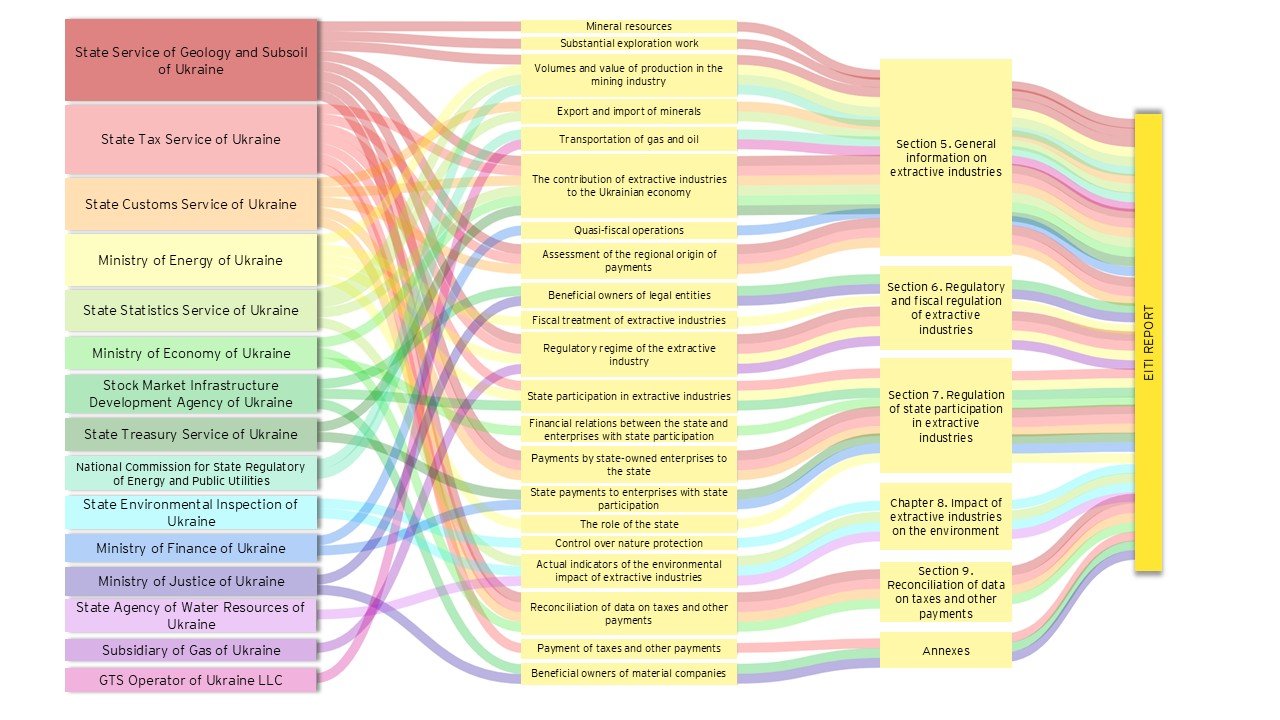
Compliance of the Ukraine EITI Report with the requirements of the EITI Standard
| - | Report section |
|---|---|
| 1.2. b | The status of disclosure of anti-corruption programs is indicated in Sections 10.2.1 and 10.2.2. Information regarding the presence of comprehensive due diligence of counterparties in the anti-corruption programs is provided in Section 10.2.3. |
| 2.1 | Description of the regulatory and fiscal framework for the extractive industries, as well as the main directions of reform, are presented in Section 6 and Section 10 of the Report, namely: Overview of legislation regulating the extraction of mineral resources, including regulatory acts in the field of taxation of extractive industries – Section 6.1 Functions and powers of government authorities in the extractive industries – Section 6.2 Reforming the regulatory and fiscal regime of the extractive industry – Section 6.3 Access to information about the beneficial owners of legal entities – Section 6.4 Fiscal regime of the extractive industry – Section 6.5 Regulatory regime of the extractive industry – Section 6.6, including: Information about the register of special permits for subsoil use and the procedure for their issuance – Sections 6.6.1 and 6.6.2 Overview of contracts in the extractive industries and other contracts related to mineral extraction – Sections 6.6.3 and 6.6.4 Use of local content in the extractive industry – Section 6.6.5 Information about state subsidies and other forms of government support that are significant for the extractive industries – Section 7.5 Description of anti-corruption legislation – Section 10.1 Commitments, plans, and reforms regarding the energy transition in Ukraine – Section 12.1 State policy on artisanal and small-scale mining – Section 5.3 |
| 2.2 | Section 6.6.2 describes the procedure for granting special permits for subsoil use (including the types of subsoil use permits granted, procedures and order of obtaining and transferring permits, criteria for granting permits, etc.), deviations from the applicable regulatory framework governing the transfer and granting of special permits, and issues related to the integration of the special permits register and the Unified State Register (USR) in terms of data exchange about beneficial owners. Information regarding auctions for the sale of special permits for subsoil use held during the reporting year and the winners of these auctions is provided in Annex 5. Information on special permits for subsoil use issued without auction during the reporting year is provided in Annex 6. Information on the extension of the validity period of special permits for subsoil use during the reporting year is provided in Annex 7. Information on amendments to special permits for subsoil use during the reporting year is provided in Annex 8. Information on changes to special permits due to the alienation (transfer) of the right to subsoil use during the reporting year is provided in Annex 9. Sections 6.6.3 to 6.6.5 describe the procedure for concluding various types of contracts in the extractive industry (Production Sharing Agreements, Joint Venture Agreements, Concession Agreements). Information on current and planned reforms on these issues is provided in Section 6.3. Information about environmental assessment, including public consultations, is provided in Section 13. Information regarding the list of auction participants, including their beneficial owners, is indicated in Sections 6.4, 6.6.2, and 7.7.3. Information on changes in the majority of ownership of companies holding special permits is provided in Section 6.4 and Annex 4. |
| 2.3 | Information about the register of special permits for subsoil use and the data available in such a register is provided in Section 6.6.1. |
| 2.4 | Information about contracts in the extractive industries and requirements for their disclosure, including details of concluded contracts and competitions for the conclusion of new contracts (where applicable), as well as information on the taxation of activities under such contracts, is provided in Sections 6.6.4 and 6.6.5. Information on reforms related to the disclosure of contracts in the extractive industries is provided in Section 6.3. |
| 2.5 | Section 6.4 provides general information regarding the legal regulation of the disclosure of ultimate beneficial owners and politically exposed persons in the extractive sector: · Information about the state policy on the disclosure of information regarding the beneficiaries of extractive industry companies, politically exposed persons, and data about such persons contained in the Unified State Register (USR). · Information on the disclosure of politically exposed persons regardless of ownership level. · Information on lowering the disclosure threshold for beneficiaries to 10%. Information about the ownership structure of extractive companies with state participation and information about state authorities and legal entities authorized to perform management functions over state-owned assets of economic entities in the state sector is provided in Section 7.7.1. Annex 4 contains information about ultimate beneficial owners and politically exposed persons related to significant extractive companies, including: Information about ultimate beneficial owners (controllers) and politically exposed persons. Information on the presence or absence of ownership structure of significant extractive companies in the USR. Cases of disclosure of information about beneficiaries with ownership shares of 10% or more. |
| 2.6 | Information about state participation in the extractive industries is contained in Section 7 and Annexes 3 of the Report. Requirement 2.6 a) and i): Definition of "state-owned enterprises" – Section 7.1 Explanation of the role of state-owned enterprises in the extractive industries – Section 7 Rules and practices of relations between state-owned enterprises and the state: Rules regarding the financing of state-owned enterprises’ activities – Section 7.3.1 Information on retained earnings, reinvestments, and external financing – Sections 7.3.1, 7.3.2 Rules on dividend distribution and payment of part of the net profit by state-owned enterprises – Sections 7.3.1, 7.4.1 Information on dividends – Section 7.4.2 Information on the state’s role in supporting the energy sector’s needs – Section 7.8 Information on quasi-fiscal operations – Section 7.9 Functions of state-owned enterprises and payments by economic entities to state-owned enterprises – Section 7.6 Requirement 2.6 a) ii): State’s share in the charter capital of extractive enterprises – Section 7.2.1 Rules regarding the state’s responsibility for covering the costs of state-owned enterprises – Section 7.2.2 Extent of the state’s liability for obligations of extractive companies – Sections 7.2.1, 7.2.2, Annex 3 Role and responsibility of the state within Production Sharing Agreements (PSA) and Joint Venture Agreements (JVA) – Sections 6.6.3, 6.6.4, 7.2 Loans and state guarantees for borrowings – Section 7.5.3 Overview of types of payments by the state to state-owned enterprises (including state support and aid measures) – Section 7.5 Requirement 2.6 b): Information on audit and disclosure of financial statements of state-owned enterprises – Section 4.3 Financial statements and independent auditor’s reports of extractive state-owned enterprises (requirement 2.6 b) – Annex 10 Requirement 2.6 c): State policy on the management of economic entities in the state sector, including current and planned reforms in public administration – Section 7.7 Requirement 2.6 d): Disclosure by state-owned enterprises of information on investments in extractive industries and how their investment decisions align with the energy transition and climate risks – Section 7.7.5 Requirement 2.6 e): Information on ultimate beneficial owners of significant suppliers to state-owned enterprises – Section 7.7.3 Unless otherwise stated, contextual information, including regarding state participation in extractive industries, applies only to companies identified as significant and included in the scope of payment reconciliation in favor of the state (Appendix 3). |
| 3.1 | Information regarding significant exploration activities is provided in Annex 1. |
| 3.2 | Information regarding mineral reserves is provided in Annex 1. Information regarding the volumes of mineral extraction (in physical units) is provided in Annex 1. Information regarding the value of extracted minerals is provided in Annex 1. |
| 3.3 | Information regarding export and import is provided in Annex 1. Disaggregated information on the export and import of minerals covered by the EITI 2024 Report, broken down by regions of Ukraine, is not available in the official statistics. |
| 4.1 | Information regarding taxes and other state revenues from the extractive industries is presented in Section 14, as well as in Annexes 11, 12, 13, and 14. Information about tax expenditures, amounts of tax adjustments that reduce the taxable financial result, and tax incentives granted to significant extractive companies is provided in Section 9.4. Information on tax and other state revenues from all extractive industry companies (both those subject to reconciliation and those whose revenues were deemed insignificant) for all types of payments is available on the websites www.eiti.org.ua and www.eiti.gov.ua |
| 4.2 | Information regarding the sale of the state's share of profit oil produced under the implementation of PSA is disclosed in Section 6.6.3: Volumes and value of the product received by the state Amounts credited to the budget from the sale of the state's share of the product Status of disclosure of information about natural gas buyers Status of disclosure of natural gas purchase and sale agreements concluded with the Subsidiary Company "Gas of Ukraine". |
| 4.3 | In Ukraine, barter and infrastructure agreement mechanisms with the state are not used. This was confirmed in the EITI MSG decision dated May 24, 2024. However, relevant questions regarding these agreements were included in the Additional Inquiry for extractive companies, and based on the analysis of responses, no instances of barter agreements between extractive companies and the state were identified. Information about infrastructure payments incurred in 2024 under contracts concluded as part of the approval of special permit conditions is provided in Section 5.2.2. |
| 4.4 | Information regarding the transportation of oil and gas, including transit activities, is provided in Annex 1. |
| 4.5 | · Information about transfer payments (grants, subsidies, subventions) from the state to extractive companies with state participation – Sections 7.5.1 and 7.5.2 Information about dividends of extractive companies with state participation – Section 7.4.2.2 (dividends of subsidiaries of National Joint Stock Company Naftogaz of Ukraine JSC), Section 14.2 (overall reconciliation results), Annex 10 (Section 10.10) Relations between the state and state-owned enterprises within the framework of JVAs, concession agreements, and PSAs – Sections 6.6.3, 6.6.4, 7.2 Based on the survey results, no cases of loans provided by accountable state-owned enterprises to other accountable state-owned enterprises were identified. Overview of types of payments by state-owned enterprises to the state – Section 7.4.2 |
| 4.6 | Taxes are paid into accounts opened in the state treasury and are subsequently redistributed among budgets of different levels. At the same time, according to the results of the technical and economic assessment and decisions of the EITI MSG, the following payments, which are distributed among budgets of different levels, are included in the scope of the report, with information provided in the respective sections, namely: Profit tax – Section 14.3.2, Annex 11 (Section 11.2) Personal income tax and levy – Section 14.3.1, Annex 11 (Section 11.1) Land fee from legal entities – Section 14.3.7, as well as Annex 11 (Section 11.7) Environmental tax – Section 14.3.8, Annex 11 (Section 11.8) - Production royalty for extraction of minerals of national i (included in the total rent payment for subsoil use) – Section 14.3.3, Annex 11 (Section 11.3) Information regarding the rules for the distribution of tax revenues among budgets of different levels by specific tax/levy is provided in Section 8.1. |
| 4.7 | The Report presents disaggregated information on state revenues from the extractive industries: By types of payments and material companies – Section 14, Annexes 11, 13 By specific types of payments and project activities of material companies – Annex 12 |
| 4.8 | The EITI Report for 2024 was published in 2025. |
| 4.9 | Information regarding the disclosure and availability of financial statement audits according to international standards is provided in Annex 10. More details about the audit procedure in extractive companies and government bodies are in Section 4.3. According to the decision of the EITI MSG dated August 26, 2025, the completeness and accuracy of data are confirmed by: - From extractive companies (both private and state-owned) – signatures of senior officials of these companies, guaranteeing the correctness of the data provided, and/or external auditor’s opinions on the provided data (if such opinion is available), for each company. In case extractive companies submit the Report on payments to the state digitally through the EITI digital system, the data accuracy will be confirmed by the qualified electronic signature of the respective officials of such extractive companies. - From central and regional government authorities – signatures of senior officials of the respective authority, as well as principles of interaction between different government bodies. |
| 4.10 | Information about policies and practices for monitoring extractive companies' expenditures and managing revenue loss risks is provided in Section 9.1. Information on the disclosure status of tax audit reports, audits of reimbursable expenses, including additional assessments and expenses identified as non-taxable and non-reimbursable, is provided in Section 9.2. Information on declared project implementation expenses, including operational and capital expenditures, particularly expenses since the start of the project implementation, is provided in Section 9.3. |
| 5.1 | Information regarding the distribution of tax revenues among budgets of different levels is provided in Section 8.1 and Section 14. |
| 5.2 | Information regarding the distribution of tax revenues among budgets of different levels and significant payments not credited to the budget is provided in Section 8.1 and Section 14. Gender aspects of the extractive sector are disclosed in Section 11. |
| 5.3. | The description of the budget process in Ukraine, as well as an overview of requirements for auditing and evaluating the efficiency of budget management, is provided in Section 8.2.2. Gender aspects of the extractive sector are disclosed in Section 11. |
| 6.1 | Information regarding the actual expenditures of extractive companies on social and environmental purposes is provided in Section 5.2. Information on the disclosure of social and environmental payments required by legislation, contracts, as well as voluntary social and environmental payments, is provided in Section 5.2.2. Gender aspects of the extractive sector are disclosed in Section 11. |
| 6.2 | Information regarding quasi-fiscal operations of gas extraction companies is provided in Section 7.9. |
| 6.3 | Information regardin the contribution of the extractive industries to the country's economy is provided in Section 5. |
| 6.4 | Information regarding the impact of the extractive industries on the environment is provided in Section 13, specifically: - Regulation of legal relations concerning environmental protection – Section 13.1.1 - Authorities responsible for managing environmental protection and controlling the activities of economic entities – Section 13.1.2 - Rights of natural resource users and obligations regarding environmental protection and restoration – Section 13.1.3 - Information on environmental control and monitoring of the extractive industry's impact on the natural environment – Section 13.1.4 - Information on rehabilitation programs, decommissioning, and closure of extractive enterprises – Section 13.1.5 - Control over compliance with environmental legislation and sanctions provided by law for violations of natural resource use rules – Section 13.2 |
* according to the data of the Ukraine national EITI Report for 2024