


Economic and social effects
Loading...
Contribution to Ukraine’s economy
Contribution to the formal industry of the economy
Contribution to Ukraine's GDP
In 2024, the contribution of the extractive industry to Ukraine's GDP amounted to UAH 307.17 billion. It increased by 8.35% compared to 2023 but did not reach the value before the full-scale invasion – UAH 351.19 billion in 2021. Moreover, the share of the extractive industry in Ukraine's GDP fell compared to 2023 to 4.01%. The decrease is likely due to an increase in Ukraine's GDP in actual prices by 15.6% (UAH 7,658.66 billion in 2023).
The State Statistics Service published only aggregated data on the contribution of individual extractive industries to the GDP by type of economic activity. Therefore, the EITI Report for 2024 presents aggregate data on the contribution of extractive industries to Ukraine's GDP.
In 2023, the contribution of the extractive industry to Ukraine's GDP amounted to UAH 262.56 billion and increased by 14.2% compared to 2022, however did not reach the level before the full-scale russian invasion (UAH 351.19 billion in 2021). Moreover, the share of the extractive industry in Ukraine's GDP decreased compared to 2022 to 4.02%. The drop is most likely due to the increase in Ukraine's GDP in effective prices by 24.8% (UAH 6,537.83 billion – 2023).
The data on the contribution of individual extractive industries to GDP are published by the State Statistics Service only in aggregate form by type of economic activity. Therefore, the EITI Report 2023 presents the aggregate data on the contribution of extractive industries to Ukraine's GDP.
The direct contribution of this industry to the GDP of Ukraine in 2022 was 5.69%. The full-scale invasion of Russian troops on the territory of Ukraine significantly affected the activities of Ukrainian enterprises, which led to a drop in the nominal GDP of Ukraine by UAH 259.82 billion (by 4.77%) compared to the previous reporting period. Thus, in 2022, a negative growth rate of the GDP of extractive industries was observed by 15.83%, with a corresponding decrease in the GDP indicator by UAH 55.6 billion in monetary terms. Data on the GDP of individual extractive industries by types of economic activity are published by the State Statistics Service only in an aggregated form.
In 2021 the total GDP of Ukraine amounted to UAH 5,459.57 billion, and the share of the "Mining Industry and Quarry Development" sector in the total GDP of Ukraine reached 6.67%.
The contribution of extractive industries to GDP in 2021 is noticeable increased from 4.57% in 2020 and is the highest in the last 9 years. In monetary terms, the direct contribution of extractive industries to GDP in 2021 equaled 364.20 billion UAH, and in the previous year 2020 - 193.12 billion UAH. The actual GDP growth of the "Mining industry and quarry development" sector was 88.59%, while the growth rate of the total GDP of Ukraine in 2021 was much slower and reached 29.31%.
Direct contribution of all extractive industries of Ukraine to its GDP in 2020 amounted to UAH 190.34 billion, or 4.54% of the GDP. Compared to 2019, the gross value added of extractive industries decreased by UAH 32.01 billion, or 14.4%.
As of the time of preparation of this EITI Report 2020, the detailed annual information on output and GDP by individual extractive industries has not yet been published by the State Statistics Service. Therefore, this report provides only aggregate information on the output of all extractive industries together and their aggregated contribution to the GDP. According to the State Statistics Service official information publication calendar for 2021, the detailed data on output and GDP for 2020 will be only published by the State Statistics Service on December 30, 2021.
The gross value added generated by the extractive industries in 2019 amounted to UAH 222.37 billion which made a direct contribution to Ukrainian GDP of 5.59%. Despite the fact that the gross value added generated by the extractive industries in monetary terms continued to grow and increased from UAH 214.26 billion in 2018 to UAH 222.37 billion in 2019, the share of extractive industries in Ukrainian GDP decreased compared to 6.01 % in 2018. The trend is due to the fact that Ukrainian economy as a whole grew faster than the extractive industries: Ukrainian GDP in 2019 grew by 11.63% from the previous year, and gross value added of extractive industries – only by 3.78%.
As of the time of preparation of this EITI Report for 2019, the State Statistics Service has not yet published annual detailed data on national output and GDP by type of economic activity. According to the official calendar of information disclosure for 2020, the State Statistics Service will publish output in the GDP for 2019 not before December 30, 2020. In view of this, the report presents only the total contribution of all extractive industries to Ukrainian GDP without detailing by sector.
The value of production of extractive industries (the output value) in 2018 amounted to UAH 490.11 billion. Their direct contribution to the output of products and services in Ukraine amounted to 5.51%, including 1.84% of output in the economy that was generated by the crude oil and natural gas extractive industry and 1.28% generated by the coal and lignite mining industry. Due to the fact that publicly available statistical information of the State Statistics Service does not allow disaggregating data on the output of each separate branch of mining of metals, clays, sand and building stones, only the estimate of their total contribution to the output in Ukraine is possible, which is 2.39 %.
In 2018, the extractive industries generated UAH 214.26 billion in gross value added, which is 6.02% of Ukraine's nominal GDP. The largest contribution to GDP was made by the crude oil and natural gas extractive industry (2.79%). The gross value added indicator outlines the value of the final product of the industry without intermediate consumption, and thus shows how efficient the industry is in terms of generating net value added in the economy. The share of the crude oil and natural gas extracting in Ukraine's GDP is one and a half times higher than its share in the output. So, the oil and gas extractive industry is the most efficient one among other extractive industries.
Contribution to exports
In 2024 the value of exported products of the extractive industry amounted to USD 3,086 million in 2024 and increased by 46.21% compared to 2023. The share of minerals in the total exports of goods in 2024 was 7.39%, which is 1.59 percentage points more than in 2023.
Highest export value is observed for iron ores (agglomerated and non-agglomerated), fire clays, titanium ores, coal and oil. It should be noted that the export value of the 6 groups of commodities mentioned earlier increased by USD 956.59 million (45.5%) compared to 2023.
In the above group of commodities, non-agglomerated and agglomerated iron ores made the largest contribution to the exports – 3.7% and 3.0%, respectively. The contribution of other commodities does not exceed 0.3%.
In 2024, the value of exports of sand (quartz and silica sand) and construction stones amounted to USD 0.48 million and USD 19.68 million, respectively, accounting for 0.001% and 0.05%, respectively, of the value of exports of commodities. The value of exports of construction stones increased in 2024 compared to 2023 by 153.13%, however it did not reach the level before the full-scale invasion – USD 28.58 million (0.04% of total exports of commodities) in 2021. The value of exports of sand (quartz and silica sand) increased by 64% in 2024 compared to 2023. The value of exports of manganese ores amounted to USD 6.56 million in 2024, while in 2023 there were no exports of manganese ores. Due to the introduction of a zero export quota for natural gas of Ukrainian origin in 2024, no exports of natural gas were carried out.
In 2023, the value of the exported extractive industry products amounted to USD 2,110.61 million and decreased by 39.2% compared to 2022. The share of minerals in the total exports of goods in 2023 was 5.8%, which is 2.0 percentage points less compared to 2022.
Iron ore, high-melting clay, oil, titanium ore and coal have the highest export value. However, the export value of the six above mentioned groups of goods decreased by USD 1,315.59 million (38.5%) compared to 2022.
In this group of commodities, non-agglomerated and agglomerated iron ores are the largest contributors to the exports of goods (2.7% and 2.2%, respectively). The contribution of other commodities does not exceed 0.5%.
In 2023, the value of exports of sand (quartz and silica) and construction stones amounted to USD 0.29 million and USD 7.78 million, respectively, or 0.001% and 0.02%, respectively, of the value of exports of goods. The value of exports of construction stones increased in 2023 compared to 2022 by 34.5% however did not reach the level before the full-scale russian invasion – USD 28.58 million (0.04% of total exports of goods) in 2021. The value of exports of sand (quartz and silica) demonstrated a downward trend during 2021 - 2023 (USD 5.67 million in 2021, USD 0.98 million in 2022). Manganese ores and natural gas were not exported in 2023. The value of manganese ore exports did not exceed USD 0.09 million during 2021-2023. The value of natural gas exports was USD 47.04 million in 2021, USD 44.73 million in 2022. There was no natural gas exports in 2023 due to the introduction of a zero quota for the export of natural gas of Ukrainian origin.
Due to the lack of public data from the State Statistics Service regarding Ukraine's foreign trade in mining products in 2022, in this report the Independent Administrator used data provided by the State Customs Service in response to a request. Therefore, some categories of extractive industries may differ from those described in similar sections in previous EIA Reports. Thus, the dynamics of indicator changes are not presented in this section.
The total value of export of products of extractive industries, according to the data of the Ministry of Internal Affairs, in 2022 amounted to 3,473.57 million dollars. USA, which is 7.86% of the total value of exports of goods and services of Ukraine. The largest export volumes (2,912.97 million US dollars) were in the field of iron ores and concentrates, the export value of which is 6.59% of the total value of exported goods and services of Ukraine. Coal and anthracite (0.49%), titanium ores (0.29%) also account for a significant share of export value. Instead, no exports of manganese ores and concentrates were observed in 2022.
Information for some categories of UKTZED in this section may cover broader categories of industries than those provided for in the context part of the 2022 EIA Report. This is explained by the DMS approach to data collection and accounting.
In 2021 the total value of goods and services exported from Ukraine amounted to 79,326.10 million dollars. USA, and the share of production of extractive industries in it increased to 5.63% (4.94% - in 2020). The value of exports of extractive industries in 2021 reached 4,468.75 million dollars. of the USA, which is 52.33% more compared to 2,933.56 million dollars. USA in the previous year.
The most significant of all mining industries remains the export value of non-agglomerated iron ores, which amounted to 4.94% of all exports of goods and services from Ukraine in 2021. It was due to the increase in the value of iron ore exports (by 54.11% compared to 2020) that the total contribution of the mining industries to the export of goods and services from Ukraine increased. Also, a significant increase (by 51.98% compared to 2020) is observed for the export value of refractory clays. At the same time, the export of manganese ores decreased significantly (by 99.18% compared to 2020).
The export value of extractive industries in 2020 was 2,993.56 million dollars. USA, which is 33.96% more than last year.
In 2020, the share of exports of extractive industries in the value of total exports of Ukraine increased to 5.96% compared to 3.42% in 2019. This is due primarily to the increase in the value of the exported volume of non-agglomerated iron ores by 43.28% compared to 2019. In 2020, the contribution of non-agglomerated iron ores to the export volume of Ukraine amounted to 5.17%, which exceeds the contribution of other mining industries combined.
The contribution of extractive industries to the export of goods and services from Ukraine increased to 3.42% in 2019 from 2.93% in 2018. In particular, the export (in monetary terms) of non-agglomerated iron ores increased significantly: from USD 1,257.96 million. USA in 2018 to 1,774.26 million dollars. USA in 2019. The export of iron ores generated 2.77% of the value of all exports of goods and services from Ukraine in 2019. Other industries made a relatively smaller contribution to exports: mining of refractory clays - 0.34%, titanium ores - 0.24%, production of pebbles, gravel, crushed stone - 0.06% and others. Natural gas was not exported from Ukraine in 2019.
The contribution of extractive industries to exports in 2018 was 2.93% of the total export of goods and services from Ukraine. The extractive industries shown in the chart below collectively exported products worth $1,679.85 million. USA. Among them, the export of iron ores (non-agglomerated) is in the first place in terms of export volume: iron ores worth 1,257.96 million dollars were exported. USA, which was 2.20% of the total export of goods and services from Ukraine. The contribution of all other extractive industries to exports was comparatively insignificant.
Natural gas and crude oil were not exported in 2018.
Contribution to income for the benefit of the state
According to data received from the state authorities, the share of the contribution of material reporting industries to the revenues of the Consolidated Budget of Ukraine and the total unified social contribution amounted to 4.71% in 2024, which is UAH 172,238,074.24 thousand. Oil and natural gas extraction is the leader among the extractive industries – it generated the largest contribution of 3.51%.
According to data from state authorities, in 2023, the share of contribution of the reporting extractive industries to the revenues to the Consolidated Budget of Ukraine and the total volume of the single social contribution amounted to 4.79%, which is UAH 150,754,831.94 thousand. Oil and Natural Gas Extraction industry generated the largest contribution among the extractive industries, namely 3.83%.
According to the data of the state authorities, in 2022, the share of the contribution of accountable extractive industries in the revenues of the Consolidated Budget of Ukraine and the total amount of the single social contribution amounted to 11%, which is 188,422,642.59 thousand UAH. The largest contribution among the extractive industries, namely 7.98% was accumulated by the industry "Extraction of oil and natural gas". Compared to 2021, there was a negative increase in the volume of tax and non-tax payments by 13.03%, mainly due to a decrease in the share of revenues from the "Iron ore extraction" industry by UAH 30,126,702.37 thousand (-61.82%).
According to the data of state bodies (DPS, DMS, Derzhgeonadra), in 2021 the total amount of payments of accountable extractive industries to the state reached 216,642,527.55 thousand UAH. The share of these payments in all tax and non-tax revenues of the Consolidated Budget of Ukraine and the total volume of revenues of the EUS amounted to 10.80% in 2021.
The volume of tax and other payments from accountable extractive industries for the benefit of the state in 2021 increased by 16.06%, compared to 2020 (186,658,453.51 thousand UAH). The majority of revenues, namely 62.06%, was accumulated by the oil and natural gas extraction industry. However, the largest increase in payments was observed precisely from iron ore mining enterprises - more than 5 times, from UAH 9,439,908.01 thousand in 2020 to UAH 48,733,122.77 thousand.
According to the data of the state bodies (DPS, SMS, Ministry of Economy, State Geodesy), the total amount of payments of accountable extractive industries to the state in 2020 amounted to UAH 186,658,453.51 thousand, which is 12.89% more than in 2019. A significant share of payments in favor of the state from accountable extractive industries, namely 80.01%, fell on the oil and natural gas extraction industry.
In 2020, the share of payments from accountable extractive industries in all tax and non-tax revenues of the Consolidated Budget of Ukraine and the total volume of revenues of the State Budget was 11.21%. Of them, the share of the oil and natural gas extraction industry was 8.97%.
In 2019, the volume of revenues for the benefit of the state from companies in the accountable mining industries, according to the data of state bodies (DPS, LMS, Ministry of Economy, State Geological Survey), amounted to UAH 165,350,870.54 thousand. The largest contribution in payments for the benefit of the state among the extractive industries falls on the industry of oil and natural gas extraction - UAH 131,378,111.59 thousand. In general, the share of payments of the accountable extractive industries in tax and non-tax revenues of the Consolidated Budget of Ukraine and the total amount of revenues of the EUS was 10.62%
In 2018, the volume of revenues for the benefit of the state from companies in the accountable extractive industries, according to the data of state bodies (DPS, LMS, Ministry of Economy, State Geodesy), amounted to UAH 187,938,735.57 thousand. The largest contribution to payments for the benefit of the state among the extractive industries is the oil and natural gas extraction industry - UAH 151,109,249.38 thousand. The specific weight of payments of the accountable extractive industries in tax and non-tax revenues of the Consolidated Budget of Ukraine and the total amount of revenues of the EES amounted to 13.36%
Contribution to capital investments
In 2024, the share of capital investments in the extractive industry and quarry development accounted for UAH 63,570.12 million or 8.56% of the total capital investments in all Ukrainian sectors, with the largest share of investments in the extraction of crude oil and natural gas (5.49%). Compared to 2023, the volume of capital investments in the extractive industry remained almost unchanged – it decreased by UAH 119.9 million from UAH 63,689.01 million in 2023.
The results of the reporting period demonstrate that the largest volumes of capital investments are in three extractive industries: Extraction of crude oil and natural gas – 64.18%, Extraction of hard and brown coal – 15.43%, and Extraction of iron ores –14.44%.
In 2023, the State Statistics Service recorded an increase in the total volume of capital investments in Ukraine by 53.12%. In 2023, the extractive industry and quarry development attracted UAH 63,689.01 million of capital investments, which is 10.15% of the total volume of capital investments of all industries in Ukraine in the reporting period. The largest share was investments in the extraction of crude oil and natural gas (6.31%). Compared to 2022, the volume of capital investments in the extractive industry increased by 50%. However, it should be noted that the increase is the result of a low base line – UAH 25,396.42 million in 2022. Anyway, the indicator for 2023 exceeded the level before the full-scale invasion – UAH 61,307.91 million in 2021.
According to the results of the reporting period, the largest volumes of capital investments were generated in three extractive industries: Crude Oil and Natural Gas Extraction (62.31%), Hard and Brown Coal Extraction (18.02%), and Iron Ore Extraction (14.16%).
In 2022, according to the data of the State Statistics Service, a decline in the total volume of capital investments in Ukraine by 39.21% was recorded. Accordingly, compared to the previous reporting period, there was a decrease in the volume of capital investments in all mining industries. In particular, capital investments in the amount of UAH 25,396.42 million (6.20% of all industries in Ukraine) were attracted to the extractive industry and quarry development, which is 58.6% less compared to 2021. In 2021, the indicator was UAH 61,307.91 million.
According to the results of the reporting period, the largest volumes of capital investments fell on three mining industries: 39.28% - on the "Iron ore mining" industry, 27.49% - on "Stone and lignite mining" and 23.63% - on "Extraction of crude oil and natural gas".
In 2022, the industry "Extractive industry and development of pits" remains the leading industry in terms of the volume of directed capital investment. In 2022, this industry accounted for 20.14% of all capital investments of industries in Ukraine. In terms of regions of Ukraine, the largest share of capital investments in the extractive industries was recorded in the Dnipropetrovsk region - 31.64%, in the city of Kyiv - 23.01%, and in the Poltava region - 22.80%. In general, capital investments in extractive industries among other types of industry in 2022 prevailed in Donetsk and Poltava regions, and amounted to 89.8% and 70.6%, respectively.
The volume of capital investments of such type of economic activity as "Mining Industry and Quarry Development" amounted to UAH 55,616.8 million in 2021. They make up 10.52% of the total volume of capital investments made in the economy of Ukraine.
Of all the extractive industries, the largest contribution to capital investments falls on the industry of iron ore extraction (4.74% of all capital investments in Ukraine or UAH 25,066.15 million) and extraction of natural gas and crude oil (3.58% of all capital investments in Ukraine or UAH 18,951.69 million).
Of all sectors of the extractive industry, almost half, namely 45.07% of capital investments fell on the sector of iron ore extraction, 34.08% - on the sector of natural gas and crude oil extraction. In third place behind them is the mining of hard and brown coal with a share of 13.40% of the total volume of capital investments in all mining industries in 2021.
By regional distribution, significant capital investments made in mining industries were attracted in Dnipropetrovsk (32.47% of all capital investments investments in extractive industries), Poltava (18.25%) oblasts and the city of Kyiv (33.55%).
In 2020, the volume of capital investments in the extractive industries amounted to UAH 44,755.57 million or 10.66% of the total volume of capital investments of Ukraine. Among them, 42.96% fell to the industry of iron ore extraction, 33.87% - to the industry of natural gas extraction, 14.33% - to the industry of stone and lignite extraction.
Significant amounts of capital investments in 2020 were attracted in the following regions: Kyiv - 35.92% of the total investments of extractive industries or UAH 16,075.63 million, Dnipropetrovsk region - 32.53% or UAH 14,558.36 million, Poltava region - 15.79% or UAH 7,066.61 million. Compared to the previous year, the share of the city of Kyiv decreased (in 2019 – 48.22%), but the share of Dnipropetrovsk and Poltava regions increased (in 2019 – 27.75% and 11.47%, respectively). It is worth noting that capital investments in extractive industries accounted for 71.79% of all capital investments in Poltava Oblast and 51.11% in Dnipropetrovsk Oblast.
Capital investments in extractive industries accounted for 10.98% of all capital investments in Ukraine in 2019 (9.33% in 2018). The largest volume of capital investments was attracted in the field of natural gas extraction, iron ore extraction, and stone and lignite mining: the contribution of these industries to capital investments in Ukraine was 5.18%, 3.45%, and 1.34%, respectively.
Traditionally, the largest share of capital investments in of extractive industries fell to the city of Kyiv - 48.22% of all capital investments in extractive industries, and to the Dnipropetrovsk region - 27.75%. In Poltava region, in 2019, capital investments were attracted significantly more than in 2018, accordingly, it accounted for 11.47% of the total volume of capital investments in extractive industries in 2019, and, in comparison, last year - 7.96%. The share of Donetsk region in 2019 was 7.56%.
Mining industries in 2018 attracted UAH 53,984.58 million in capital investments, which accounted for 9.33% of the total capital investments of all sectors of the Ukrainian economy. Among them, the natural gas extraction industry (4.38%) and iron ore mining industry (2.54%) made the largest contribution to attracting investments for capital projects.
Of the total volume of capital investments in all mining industries, almost half, namely 48.85%, was attracted in the city of Kyiv 27.30% - in Dnipropetrovsk region, 9.17% - in Donetsk region, 7.96% - in Poltava region, the rest in other regions of Ukraine.
Contribution to employment and gender structure of employment in extractive industries
Before the full-scale russian invasion of Ukraine, the EITI Reports provided data on the average number of full-time employees (including by gender) in the extractive industries, obtained from the State Statistics Service in response to a request from the Independent Administrator. Obtaining the specified data for 2024 turned out to be impossible in accordance with the Law of Ukraine “On Protection of the Interests of Subjects of Reporting and Other Documents during the Period of Martial Law or a State of War”, since individuals, individual entrepreneurs, legal entities have the right not to submit statistical reporting during martial law. That is why the state statistics bodies were unable to generate objective statistical information.
According to the reports actually submitted by the enterprises and the reassessments of the State Statistics Service indicators, the number of employees employed by economic entities in the extractive industry and quarry development amounted to 138 thousand people, or 1.83% of the total number of employed people in Ukraine. Also, 40 thousand people worked in the metal ore mining industry, of which 28 thousand people were in the iron ore mining industry. 39 thousand people worked for business entities in the crude oil and natural gas mining industry, which is 0.51% of the employees employed by business entities in Ukraine. 16 thousand people worked in the stone, sand and clay mining industry (0.21% of the total employees in Ukraine). The information will be clarified after the statistical data are updated.
Before the full-scale russian invasion, the EITI Reports provided data on the average number of full-time employees (including by gender) in the extractive industries, obtained from the State Statistics Service in response to a request from the Independent Administrator. Obtaining the specified data for 2023 turned out to be impossible due to the Law of Ukraine “On Protection of the Interests of Subjects of Reporting and Other Documents during the Period of Martial Law or a State of War”, since individuals, individual entrepreneurs, and legal entities have the right not to submit statistical reports during martial law. This made it impossible for state statistics bodies to form objective statistical information.
According to the reports submitted by the enterprises and the reassessments of the indicators calculated by the State Statistics Service, the number of employees in the extractive industry and quarry development business entities was 147 thousand people, which is 1.95% of the total number of employees in Ukraine. Of them, 44 thousand people were employed in the metal ores mining industry, including 31 thousand people – in the iron ore mining industry. 38 thousand people worked in the crude oil and natural gas extractive business entities, which is 0.50% of the employees of business entities in Ukraine. 17 thousand people were employed in the stone, sand and clay mining industry (0.22% of the employees of Ukraine).
In previous EITI Reports, data on the average accounting number of full-time employees (including distribution by gender) in extractive industries, received from the State Statistics Service in response to a request by the Independent Administrator, were provided. Obtaining the specified data for the year 2022 turned out to be impossible in accordance with the Law of Ukraine "On the Protection of the Interests of Subjects of Reporting and Other Documents during the Period of Martial Law or State of War", since natural persons, natural persons-entrepreneurs, and legal entities during martial law have the right not to submit statistical reports. This made it impossible for the state statistics authorities to form objective statistical information.
Thus, the state statistics authorities suspended the publication of statistical information, including the average registered number of full-time employees in total and by gender, during the period of martial law and within three months after its end. In connection with the above information, it is inappropriate to compare the data presented in this section with the data of previous EIA Reports.
In 2021, the average registered number of full-time workers in the extractive industries amounted to 184,000 people, which is 1.29% less than in the previous year. At the same time, the total number of full-time employees in Ukraine decreased even more - by 3.39%. The share of extractive industries in the total number of full-time employees in Ukraine remained almost at the same level - 2.59% in 2021 compared to 2.54% in 2020.
Of all the extractive industries, metal ore and hard coal mining traditionally have the most full-time employees - 63 and 62 thousand full-time employees, respectively. in 2021.
In 2021, men predominated in the gender structure of full-time workers in the mining industry, as in previous periods. So, in 2021, out of 184,000 full-time workers in the mining industry, 137,000 (74.46%) were men, and 47,000 (25.54%) were women. Similar to extractive industries, the entire industrial sector is significantly dominated by men in the structure of full-time employees - in 2021, their share was 62.66%. In general, in the entire economy of Ukraine, among the average registered number of full-time employees, on the contrary, women prevailed in 2021 - their share was 53.48%.
However, the share of women in extractive industries is gradually increasing. Thus, their share among full-time employees in 2018 was 24.75% and gradually increased to 25.54% in 2021.
According to the reports actually submitted by the enterprises and the reassessments of the State Statistics Service indicators, the number of employees employed by economic entities of the extractive industry and quarry development amounted to 169 thousand people, which is 2.23% of this indicator in Ukraine as a whole. On the other hand, 55,000 people worked in the field of metal ore mining, including 38,000 people in the iron ore mining industry. 39,000 people worked in economic entities in the field of crude oil and natural gas extraction, which is 0.51% of the employees of Ukrainian economic entities.
20,000 people (0.26% of Ukrainian employees) worked in the field of stone, sand and clay extraction, and about 6,000 people were involved in the economic activity of providing auxiliary services in the field of extractive industry and quarry development. employees (0.09%).
In 2020, the average registered number of full-time employees in extractive industries decreased by 4.90% compared to the previous year and amounted to 186,400 people. In general, 2.54% of the average registered number of full-time employees of Ukraine in 2020 were employed in extractive industries. Of them, 0.92% (67.4 thousand people) work in the field of coal and brown coal mining, 0.82% (59.9 thousand people) work in the field of metal ores.
As in previous years, the majority of workers in all mining industries, namely 74.68%, were male workers. On the other hand, the share of women was 25.32%. A similar trend was observed in all mining industries.
During 2016-2019, the average registered number of full-time employees in extractive industries decreased annually by an average of 5.63% and amounted to 196 thousand people in 2019. The direct contribution of extractive industries to the total average accounting number of full-time employees in Ukraine was 2.63% in 2019. Among all types of economic activity related to the mining industry, the largest number of full-time employees was employed in the mining of hard and brown coal - 72 thousand people or 0.97% of the total number of full-time employees in Ukraine. In second place was the metal ore mining industry - 65,000 people or 0.88% of the total figure in Ukraine
In 2018, the average registered number of full-time employees in the extractive industries was 202,000 people, which was 10.91% of all full-time employees in industry as a whole and 2.64% of all full-time employees in Ukraine. More than half of all workers in the extractive industries are employed at enterprises in Dnipropetrovsk (34.54%) and Donetsk regions
Procurement of State-owned companies
Procurement rules and practices of state-owned companies.
The EITI Standard requires the MSG to determine materiality and disclose the beneficial owners of contractors. The determination of materiality is necessary for the disclosure of beneficial ownership in accordance with Requirement 2.6(e).
The Law of Ukraine “On Public Procurement” establishes the foundations of state policy in the field of procurement and contains specific rules governing the procurement activities of state-owned companies.
There are rules under which procurement must be carried out through the electronic procurement system if the value of the procurement exceeds the materiality threshold.
The laws and regulations governing public procurement do not apply to the procurement of goods, works and services under production sharing agreements.
There is legal uncertainty as to whether public procurement regulations apply to companies whose corporate rights have been seized and transferred to the management of another state-owned companies.
Special rules for public procurement during martial law have been established. These rules provide, inter alia, for the possibility of not publishing in the electronic procurement system a report on a procurement contract concluded without the use of the electronic procurement system in certain cases.
Prozorro (oil and gas)
Loading...
*Prozorro is the main electronic public procurement system in Ukraine, which provides open and transparent access to tender documentation, contracts and procurement results of state-owned enterprises.
Contribution to the informal industry of the economy
The volume of the shadow economy in Ukraine is estimated by the Ministry of Economy on a quarterly basis. The results of the assessment were generally made publicly available on the official website of the Ministry.
Since 2022, the Ministry of Economy has suspended the publication of the results of these assessments.
At the time of preparation of the EITI Report 2023 and the EITI Report 2024, information on the overall trends of the shadow economy in Ukraine was not available.
For the year 2022, open sources provide information on the size of the shadow economy in the extractive industries of Ukraine according to a study conducted by the Ministry of Economy of Ukraine and data published by the State Statistics Service of Ukraine.
According to the data of the Ministry of Economy, received in response to the request of the Independent Administrator, the level of the shadow economy in 2022 was 30% according to the monetary and electric method, which is 2% less and 3% more than in 2021, respectively. According to the loss-making method of enterprises, this indicator is 31%, which is as much as 8% more than in 2021.
According to the State Statistics Service on the net profit (loss) of enterprises in 2022, 54.9% of enterprises in the extractive industry suffered losses, which is 14.8% more than the similar figure in 2021 (40.1%). The largest share of unprofitable enterprises in 2022 was observed in the field of mining of non-ferrous metal ores (81.3%), mining of ores of other non-ferrous metals (80%), as well as in the field of metal ore mining (68.6%), crude oil mining (60.5%).
To estimate the share of the shadow sector in certain branches of the economy of Ukraine, the Ministry of Economy uses the method of unprofitability of enterprises. In 2022, the level of the shadow economy increased by 15% compared to the previous year and amounted to 48%. Significant growth was also observed in the field of real estate transactions (by 13%), financial and insurance activities (11%), processing industry (11%). However, the highest level of the shadow economy is still observed in the mining industry.
The State Statistics Service of Ukraine regularly publishes information on the number of informally employed population by type of economic activity. However, the specified information for 2022 at the time of preparation of this Report is not available in accordance with the Law of Ukraine "On the Protection of the Interests of the Subjects of Reporting and Other Documents During the Period of Martial Law or State of War". The publication of statistical information on the informal employment of the population will be resumed after the end of the legally established term for the submission of statistical reports by economic entities and taking into account the time required by the state statistical authorities to generate statistical information.
According to the available data of the Ministry of Economy, the level of the shadow economy in extractive industries at the end of 2021 was 32% of the volume of gross added value of these industries. This is a significantly lower figure compared to 2020, when the level of the shadow economy in extractive industries was estimated at 41%.
According to the State Statistics Service, in 2021 the number of informally employed people in Ukraine aged 15-70 was 3,018.40 thousand people, which is equal to 19.34% of the employed population of the country. The State Statistics Service does not disaggregate data on the informally employed population in sufficient detail to obtain an indicator separately for extractive industries. However, the State Statistics Service publishes an indicator for industry as a whole - in 2021, the share of informally employed was 7.57% of the total number of workers in industry. The level of the informally employed population in industry in 2021 slightly decreased compared to a similar indicator (7.69%) in 2020.
According to the data of the Ministry of Economy, the level of the shadow economy in extractive industries in 2020 was 41%, in 2019 - 26%, and in 2018 - 29% of the gross added value of these industries.
It is worth noting that the study of the Ministry of Economy in 2020 was carried out using the improved Methodological recommendations approved by the order of the Ministry of Economy dated 20.01.2021 No. 104, according to which the concept of the shadow economy is as follows:
The shadow economy is the economic activity of a business entity that is not registered in the established order, the results of which participate in creation of gross national income, but are not fully covered by official statistics and, as a result, avoid tax obligations to the state, are characterized by a violation of legally established norms.
In 2019 and 2018, the concept of the shadow economy meant: economy - unregistered economic activity of a business entity, which is characterized by minimization of costs for the production of goods, performance of work and provision of services, evasion of taxes, fees (mandatory payments), statistical questionnaires and submission of statistical reports, the consequence of which is a violation of legally established norms (minimum wage level, duration of working hours, working conditions and safety, etc.)
According to the Order of the Ministry of Economy No. 104 of 01.20.2021, the calculation of the level of the shadow economy can be carried out using various assessment methods. According to one of these methods - the loss-making method of enterprises, the level of the shadow economy in the extractive industries of Ukraine in 2020 was 41%.
The integral indicator of the level of the shadow economy in Ukraine in 2020, according to a study by the Ministry of Economy, was 30% of the volume of official GDP. However, according to certain methods of calculating the level of the shadow economy, this indicator differs and amounts to:
► by the enterprise loss method – 27% of the official GDP;
► by the monetary method – 31% of the official GDP;
► by the “population expenditure – retail turnover” method – 22% of the official GDP;
► by the electric method (using data on electricity consumption) – 23% of the official GDP.
According to the Ministry of Economy, in Ukraine in general the level of the shadow economy was 28% of the volume of official GDP in 2019. According to certain methods of calculating the shadow economy, this indicator was:
► by the method of "population expenditure - retail turnover" - 43% of the official GDP;
► by the method of loss of enterprises - 17% of the official GDP;
► by the monetary method - 22% of the official GDP;
► by the electric method (using data on electricity consumption) - 26% of the official GDP.
For comparison, the integral indicator of the level of the shadow economy in Ukraine was 31% in 2018, which is 1 percentage point less than in 2017. The level of the shadow economy in Ukraine according to certain methods was:
► by the method of "population expenditure - retail turnover" - 46% of the official GDP;
► by the method of loss of enterprises - 20% of the official GDP;
► by the monetary method - 24% of the official GDP;
► by the electric method (using data on electricity consumption) - 27% of the official GDP.
According to the State Statistics Service, it can be estimated that the share of the informally employed population in the extractive industries of Ukraine in 2020 is 7.69%, in 2019 it can be estimated at 8.29%, and in 2018 - 8.03% of the total employment in these industries, assuming that the level of informal employment in the extractive industries industries corresponds to the level of informal employment in the entire industry of Ukraine.
According to the Order of the State Statistics Service "On Approval of Methodological Provisions for Determining Informal Employment of the Population" No. 16 of January 23, 2013, informal employment is defined as the total number of informally employed employees in both the formal and informal sectors or in households. Informal employment covers the following categories of population:
► self-employed persons and employers working in their own enterprises in the informal sector;
► unpaid family members, regardless of whether they work in formal or informal sector enterprises;
► employees performing informal work who are not covered by legal or social protection as employed persons and are not entitled to other employment-related benefits, as well as hired domestic workers in households;
► Members of informal production cooperatives.
The State Statistics Service of Ukraine regularly publishes information on the number of informally employed population by type of economic activity. However, the specified information for 2022 at the time of preparation of this Report is not available in accordance with the Law of Ukraine "On the Protection of the Interests of the Subjects of Reporting and Other Documents During the Period of Martial Law or State of War". The publication of statistical information on the informal employment of the population will be resumed after the end of the legally established term for the submission of statistical reports by economic entities and taking into account the time required by the state statistical authorities to generate statistical information.
The number of informally employed population in Ukraine aged 15-70, according to the State Statistics Service, is 3,237.8 thousand people, or 20.34% of the employed population of Ukraine. In the industry sector, this indicator is much lower - 7.69%. Namely, 181.32 thousand people out of 2,358.6 thousand people employed in industry belonged to the informally employed population in 2020.
The independent administrator made an assumption that the level (share) of informal employment in the extractive industries corresponds to that of the entire industry. Therefore, the share of the informally employed population in extractive industries in 2020 is estimated at 7.69%.
According to the State Statistics Service, among the employed population in Ukraine in 2019 in the number of 16,578.3 thousand people, 3,460.4 thousand people or 20.8% were informally employed. In the industrial sector, the level of informal employment amounted to 8.29% - 204.2 thousand people out of 2,461.5 thousand people belonged to the informally employed population.
In order to estimate the number of informally employed population separately in extractive industries, the Independent Administrator made an assumption that the level (the share of) informal employment in extractive industries is the same as in all industry. Thus, the share of the informally employed population in extractive industries can be estimated at 8.29% in 2019.
In order to estimate the size of the informal sector in extractive industries in 2018, the Independent Administrator calculated the share of the informally employed population in these industries based on data from the State Statistics Service. The need for calculation is due to the lack of official disaggregated data of the State Statistics Service on the level of informal employment separately in extractive industries, instead such data are available only for the entire industry.
It was assumed that the share of the informally employed population in extractive industries is the same as in industry. Out of 16,360,000 employed persons in Ukraine, 3,541,300 are informally employed, of which 194,800 are informally employed in industry. The share of informal employment in industry was 8.03% in 2018. If we assume that the level of informal employment in the extractive industries is the same, then the number of informally employed population in these industries was estimated at 16.8 thousand people.
Employees
Workers
Loading...
Before the full-scale russian invasion of Ukraine, the EITI Reports provided data on the average number of full-time employees (including by gender) in the extractive industries, obtained from the State Statistics Service in response to a request from the Independent Administrator. Obtaining the specified data for 2024 turned out to be impossible in accordance with the Law of Ukraine “On Protection of the Interests of Subjects of Reporting and Other Documents during the Period of Martial Law or a State of War”, since individuals, individual entrepreneurs, legal entities have the right not to submit statistical reporting during martial law. That is why the state statistics bodies were unable to generate objective statistical information.
According to the reports actually submitted by the enterprises and the reassessments of the State Statistics Service indicators, the number of employees employed by economic entities in the extractive industry and quarry development amounted to 138 thousand people, or 1.83% of the total number of employed people in Ukraine. Also, 40 thousand people worked in the metal ore mining industry, of which 28 thousand people were in the iron ore mining industry. 39 thousand people worked for business entities in the crude oil and natural gas mining industry, which is 0.51% of the employees employed by business entities in Ukraine. 16 thousand people worked in the stone, sand and clay mining industry (0.21% of the total employees in Ukraine). The information will be clarified after the statistical data are updated.
Before the full-scale russian invasion, the EITI Reports provided data on the average number of full-time employees (including by gender) in the extractive industries, obtained from the State Statistics Service in response to a request from the Independent Administrator. Obtaining the specified data for 2023 turned out to be impossible due to the Law of Ukraine “On Protection of the Interests of Subjects of Reporting and Other Documents during the Period of Martial Law or a State of War”, since individuals, individual entrepreneurs, and legal entities have the right not to submit statistical reports during martial law. This made it impossible for state statistics bodies to form objective statistical information.
According to the reports submitted by the enterprises and the reassessments of the indicators calculated by the State Statistics Service, the number of employees in the extractive industry and quarry development business entities was 147 thousand people, which is 1.95% of the total number of employees in Ukraine. Of them, 44 thousand people were employed in the metal ores mining industry, including 31 thousand people – in the iron ore mining industry. 38 thousand people worked in the crude oil and natural gas extractive business entities, which is 0.50% of the employees of business entities in Ukraine. 17 thousand people were employed in the stone, sand and clay mining industry (0.22% of the employees of Ukraine).
Obtaining data on the average number of full-time employees (including by gender) in the extractive industries from the State Statistics Service for 2022 turned out to be impossible due to the Law of Ukraine “On Protection of the Interests of Subjects of Reporting and Other Documents during the Period of Martial Law or a State of War”, since individuals, individual entrepreneurs and legal entities have the right not to submit statistical reports during martial law. This made it impossible for state statistics bodies to form objective statistical information.
Thus, the state statistics bodies suspended the publication of statistical information, including information on the average number of full-time employees in total and by gender, during the period of martial law and for three months after its termination. In view of the above, a comparison of the data presented in this section with the data published in previous EITI Reports is not appropriate.
According to the reports submitted by the companies and the reassessments of the indicators calculated by the State Statistics Service, the number of employees employed by business entities in the extractive industry and quarry development amounted to 169 thousand people in 2022, which is 2.23% of the total employment in Ukraine. At the same time, 55 thousand people were employed in the metal ore mining industry, including 38 thousand people in the iron ore mining industry. A total of 39 thousand people worked in the crude oil and natural gas extractive industry, which is 0.51% of the employees employed by business entities in Ukraine.
According to the reports submitted by the companies and the reassessments of the indicators calculated by the State Statistics Service, the number of employees employed by business entities in the extractive industry and quarry development amounted to 169 thousand people in 2022, which is 2.23% of the total employment in Ukraine. At the same time, 55 thousand people were employed in the metal ore mining industry, including 38 thousand people in the iron ore mining industry. A total of 39 thousand people worked in the crude oil and natural gas extractive industry, which is 0.51% of the employees employed by business entities in Ukraine.
In 2021, the average number of full-time employees in the extractive industries was 184 thousand people, which is 1.29% less than in the previous year. At the same time, the total number of full-time employees in Ukraine decreased even more, by 3.39%. The share of the extractive industries in the total number of full-time employees in Ukraine remained almost unchanged, amounting to 2.59% in 2021 compared to 2.54% in 2020.
Among all extractive industries, metal ore mining and hard coal mining traditionally employed the largest number of full-time employees, with 63 thousand and 62 thousand employees respectively in 2021.
As in previous periods, the gender structure of full-time employees in the extractive industries in 2021 was dominated by men. Of the 184 thousand full-time employees in the extractive industries, 137 thousand were men (74.46%) and 47 thousand were women (25.54%).
Similar to the extractive industries, men also predominated in the structure of full-time employees in the industrial sector as a whole, accounting for 62.66% in 2021. In contrast, women predominated in the overall economy of Ukraine among the average number of full-time employees, accounting for 53.48% in 2021.
At the same time, the share of women in the extractive industries has been gradually increasing. Their share among full-time employees amounted to 24.75% in 2018 and gradually increased to 25.54% in 2021.
In 2020, the average number of full-time employees in the extractive industries was 186.4 thousand people – a decrease by 4.90% compared to the previous year. Overall, the extractive industries employed 2.54% of the average number of full-time employees in Ukraine in 2020, including 0.92% (67.4 thousand people) in hard coal and lignite mining, and 0.82% (59.9 thousand people) in metal ore mining.
The average monthly salary of the extractive industries’ employees in 2020 was UAH 16,763, which is 7.25% more than in 2019. Moreover, the average monthly salary of employees in the extractive industries is 44.62% higher than the average monthly salary in Ukraine and 31.38% higher than the average monthly salary of the people employed in the industrial production industry.
As in previous years, the people employed in all extractive industries, namely 74.68%, were mostly males. The share of women was 25.32%. A similar trend was observed in all extractive industries
The average number of full-time registered employees in the extractive industries decreased annually by an average of 5.63% and in 2019 amounted to 196 thousand people. The direct contribution of the extractive industries to the total average number of full-time registered employees in Ukraine amounted to 2.63% in 2019. Among all economic activities included in the mining industry, the largest number of full-time registered employees was employed in the mining of hard coal and lignite – 72 thousand people or 0.97% of the total number of full-time registered employees in Ukraine. The second top industry was non-ferrous ores mining – 65 thousand people or 0.88% of the total in Ukraine.
The largest share of staff in the extractive industries was employed at enterprises in Dnipropetrovsk (34.41%), Donetsk (23.62%), Poltava (9.41%), Lviv (5.57%) regions. Extractive industries are important for the generating personal income, because, according to official statistics, the average wage in the extractive industries is 50% higher than in the country. While the average monthly wage in Ukraine increased by 18.41% in 2019 compared to previous year and amounted to UAH 10,497, in the extractive industries it increased by 25.52% to UAH 15,630.
The gender structure of full-time employees in all mining industries is predominated by men with a share of 74.57%, while the share of women is 25.43%. The structure of full-time employees in each mining industry is shown in the figure below
In 2018, the average number of full-time employees in the extractive industries was 202 thousand people, or 10.91% of all full-time employees in all industries and 2.64% of all full-time employees in Ukraine. More than half of all employees in the extractive industries are working at the enterprises in Dnipropetrovsk (34.54%) and Donetsk regions (22.86%).
The number of full-time employees in the extractive industries continued to decline, albeit at a slower pace: in 2017 it decreased by 8.19% compared to the previous year, and in 2018 – by 5.16%. Such employment dynamics in the extractive industries is significantly affected by the general economic downturn and the loss of control of companies over their extractive assets located in the eastern part of Ukraine in the area of Unified Forces Operations.
At the same time, the extractive industries have a significant impact on the personal income of the population, because, according to the State Statistics Service, the average salary of full-time employees in the extractive industries in 2018 was UAH 12,452, which is 40.46% more than the average salary in Ukraine (UAH 8,865). While the average wage in Ukraine in 2018 increased by 24.79% compared to 2017, in the extractive industries it increased slightly more – by 28.32%.
The bulk of full-time employees in the extractive industries, namely 75.25%, are men. The share of women in 2018 was 24.75%
Employment of foreign citizens in the mining industry
According to data provided by the State Employment Centre, 4,720 permits for the employment of foreigners and stateless persons were issued in Ukraine in 2024, including 537 to women. As of 2024, the total number of valid permits was 13,582, including 1,492 to women. In 2024, the number of permits issued for the employment of foreigners and stateless persons increased by 56.55% compared to 2023.
However, the analysis by NACE type of economic activity shows the opposite trends. In the extractive industry (section B), the number of permits issued in 2024 decreased by 73.43% compared to the previous year and amounted to only 13, of which one was to a woman. In contrast, in the transport sector (Section H), there is an increase of 65.12%, which is equal to 284 permits, including 19 for women.
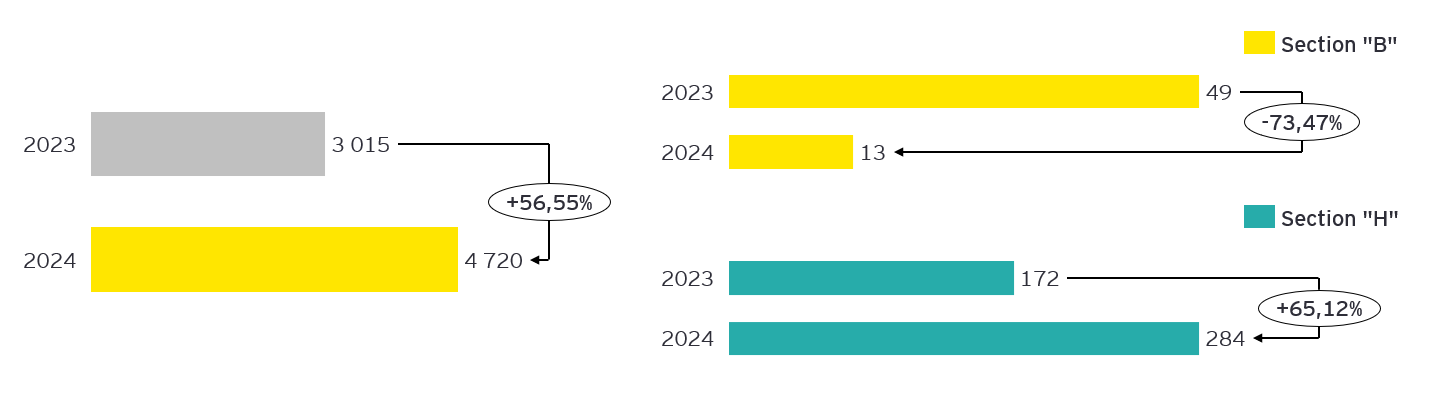 Number of permits issued for the employment of foreigners or stateless persons in all types of economic activity and by NACE type of economic activity in 2023 and 2024
As of 2024, 44 permits for the employment of foreigners and stateless persons were in force in the material reporting companies, of which 4 permits were issued during the year.
In the period from 2020 to 2023, Ukrainian extractive companies continued to actively attract foreign specialists to meet the needs for qualified labour. In 2022, due to the full-scale russian invasion of Ukraine, the number of permits issued for the employment of foreigners decreased fourfold compared to 2021. Detailed information on the number of permits issued for the employment of foreigners and stateless persons in the mining industries during this period is provided below.
According to data provided by the State Employment Centre as part of the preparation of the EITI Report for 2023, the total number of permits issued for the employment of foreigners or stateless persons continued its downward trend and amounted to 3,015 permits, which is 22.93% less than the number of permits issued in 2022. At the same time, the number of special permits issued in 2023 for NACE Section B (extractive industry and quarry development) increased by 53.13%. Despite this, Section H (transport, warehousing) demonstrated a decrease of 34.60% compared to the previous period.
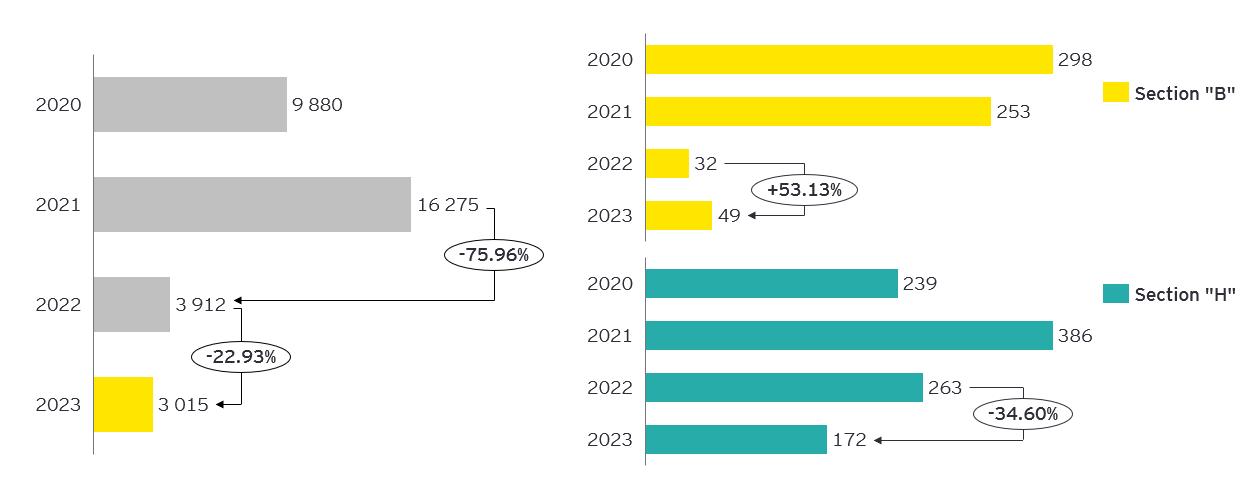 Number of permits issued for the employment of foreigners or stateless persons in all types of economic activity and by type of economic activity according to NACE in the period from 2020 to 2023
38 permits for the employment of foreigners and stateless persons were in force with the material reporting companies in 2023, nine of which were issued in that same year.
Gender pay gap
In accordance with requirement 6.3 A (IV) of the EITI Standard, companies are encouraged to disclose information on the gender pay gap. However, the current version of the EITI Law does not contain a direct requirement for reporting companies to make such disclosure. In view of this, the Independent Administrator made an additional request to the material reporting companies to disclose information on the gender pay gap.
The gender pay gap requires further attention from all stakeholders to identify possible disparities in certain extractive industries. Conducting such an analysis will allow to identify potential structural inequalities, contribute to a more inclusive development of the extractive sector and ensure compliance with international standards of transparency and sustainable development.
State aid provided
The Law of Ukraine "On State Aid to Business Entities" provides that state support measures must be checked by the Antimonopoly Committee of Ukraine ("AMCU") for eligibility for state aid, which is subject to verification on admissibility for competition.
In general, state aid to business entities is their support in any form at the expense of state or local resources, which distorts or threatens to distort economic competition, creating advantages for the production of certain types of goods or the implementation of certain types of economic activity
State aid can be provided in various forms (for example, in the form of subsidies, guarantees, an increase in the state share in the authorized capital of business entities, tax benefits, compensation for losses, etc.).
Criteria for admissibility of state aid for competition may be established by the CMU for certain categories of state aid.
In 2023, the Criteria for assessing the admissibility of state aid to economic entities in the coal industry came into force, which determined the following criteria for assessing the admissibility of state aid in this field:
-
►
Prevention of significant inequality in conditions for business activity carried out by competing business enterprises in the coal industry.
-
►
Prevention, elimination, restriction or distortion of competition in the markets of heat and electricity production.
-
►
Reduction of the impact on the environment as a result of coal production by coal enterprises which are provided with assistance for closure (liquidation).
AMCU maintains the Register of State Aid Programs at the link:
http://pdd.amc.gov.ua/portal/registry/registryofstateaid/list
The AMCU prepares an annual report on state aid granted in the previous financial year by 1 September of the following year, submits it to the CMU for approval, and publishes it in the Uryadovy Kuryer newspaper and on the Government’s website. The AMCU’s reports on state aid granted to undertakings, based on information provided by state authorities and local self-government bodies, are available at the following link:
During the period of martial law and for one year after its termination, providers of state aid were temporarily exempted from the obligation to notify the AMCU of new or existing state aid, and all state aid provided during martial law was declared admissible for competition. In addition, a rule has been established according to which certain provisions of the Law of Ukraine "On State Aid to Business Entities", in particular those regulating the maintenance of the Register of State Aid, do not apply. This made it difficult to implement the powers of the AMCU and the functioning of the national state aid control system, in particular, in the part of maintaining the Register of state aid programs and drawing up the annual report on the provision of state aid.
In 2022, the Criteria for assessing the admissibility of state aid to economic entities in the coal industry were in effect, which defines the following criteria for assessing the admissibility of state aid in this field: https://amcu.gov.ua/pro-nas/zvitnist/richni-zviti-pro-nadannya-derzhavnoyi-dopomogi
-
►
Prevention of significant inequality in conditions for business activity carried out by competing business enterprises in the coal industry.
-
►
Prevention, elimination, restriction or distortion of competition in the markets of heat and electricity production.
-
►
Reduction of the impact on the environment as a result of coal production by coal enterprises which are provided with assistance for closure (liquidation).
Such state aid may be permissible if it is provided for clearly defined purposes (liquidation of coal mining enterprises, covering exceptional costs, etc.) and covers only costs related to coal for the production of electricity, combined heat and electricity, coke production and as a fuel for blast furnaces in the steel industry.
The criteria for assessing the admissibility of state aid to economic entities for environmental protection provide for the construction or re-equipment of energy infrastructure facilities, which are subject to the tariffs and conditions of connection to the grid, determined by the legislation of Ukraine, for the purposes of environmental protection.
According to these Criteria, to facilities energy infrastructure includes equipment and facilities located on the territory of Ukraine, including those that connect it with one or more other countries, namely:
-
►
Trunk and distribution pipelines for natural gas and biogas transmission, which are part of the network, with the exception of high-pressure pipelines used for the distribution of natural gas to processing plants and/or to the final unloading terminal
-
►
Underground storage facilities connected to high-pressure pipelines used for the distribution of natural gas
-
►
Facilities for the reception, storage and regasification or decompression of liquefied natural gas (LNG) or compressed natural gas (CNG);
-
►
Any equipment or installations, including compressor stations, necessary for the safe, reliable and efficient operation of the system or to ensure its reversibility
-
►
Pipelines used for the transportation of crude oil
-
►
Pumping stations and storage facilities necessary for the operation of crude oil pipelines
-
►
Equipment or installations necessary for the proper, safe and efficient operation of the relevant system, including protection, monitoring and control systems, as well as reversing equipment
-
►
Carbon dioxide – a network of pipelines, including associated compressor stations, for the transportation of carbon dioxide to a storage site for the purpose of injecting the carbon dioxide into suitable underground geological formations for storage
At the same time, the law provides for some exceptions, including for state aid related to the provision of services of general economic interest (which include the services related to the natural gas market operations under the imposition of special obligations mechanism)
From March 2022, for the period of martial law and for one year after its termination or cancellation, state aid providers were temporarily exempted from the obligation to notify the AMCU of new or current state aid, and all state aid provided during martial law was recognized as admissible for competition.
In 2021, such state aid may be permissible if (1) it is granted for clearly defined purposes (liquidation of coal mining enterprises, coverage of exceptional costs, etc.) and (2) it covers only costs related to coal for the production of electricity, combined heat and power, coke production, and as a fuel for blast furnaces in the steel industry.
On October 11, 2021, the CMU also adopted a resolution "On the approval of criteria for assessing the admissibility of state aid to economic entities for environmental protection", which provides for the construction or re-equipment of energy infrastructure facilities, which are subject to the tariffs and conditions of connection to the network, determined by the legislation of Ukraine, for the purposes of environmental protection.
Costs that can be reimbursed to the recipient of state aid are capital investments for the construction or re-equipment of the above energy infrastructure facilities. The amount of such state aid should not exceed the difference between the costs that can be reimbursed to the recipient of state aid and the operating profit from the investments of the recipient of state aid.
Any new state aid, as well as current aid in case of significant changes to it, can be granted only after receiving a positive decision of the AMCU. State aid provided contrary to the requirements of the law is considered illegal and subject to full refund to the state or may be terminated by the AMCU.
At the same time, the Law provides for some exceptions, including for support related to the provision of services of general economic interest (among them - services in the field of functioning of the natural gas market within the framework of the imposition of special obligations).
AMCU maintains the Register of State Aid Programs at the link:
http://pdd.amc.gov.ua/portal/registry/registryofstateaid/list.
AMCU annually publishes reports on the provision of assistance to business entities based on information provided by state and local self-government bodies and publishes them at the link: https://amcu.gov.ua/pro-nas/zvitnist/richni-zviti-pro-nadannya-derzhavnoyi-dopomogi.
State aid received
State aid received
Loading...
The Law of Ukraine "On State Aid to the Business Enterprises" stipulates that state support measures should be reviewed by the Antimonopoly Committee of Ukraine (the "AMCU") to identify the measures qualifying as state aid, which is subject to review for its competition permissibility.
Generally, support to business entities in any form at the expense of state or local resources, which distorts or threatens to distort economic competition, creating advantages for production of certain goods or certain economic activities, is considered "state aid".
State aid may be provided in various forms (e.g., in the form of subsidies, guarantees, increase in the state share of the charter capital of business entities, tax benefits, compensation of losses, etc.).
The criteria for permissibility of state aid may be set by the CMU for certain categories of state aid.
For instance, according to the results of public discussions during 2019-2020, 13.01.2021 the CMU adopted the resolution "On Approval of the Criteria for Permissibility of State Aid to Companies in the Coal Industry", which defines the following criteria for assessing the eligibility of state aid in this area:
-
►
Prevention of significant inequality in conditions for business activity carried out by competing business enterprises in the coal industry.
-
►
Prevention, elimination, restriction or distortion of competition in the markets of heat and electricity production.
-
►
Reduction of the impact on the environment as a result of coal production by coal enterprises which are provided with assistance for closure (liquidation).
Such state aid may be eligible if (1) it is provided for clearly defined purposes (liquidation of coal mines, coverage of exceptional costs, etc.) and (2) covers only costs related to coal for electricity generation, combined heat and power generation, coke production and as a fuel for blast furnaces in the steel industry.
Any new state aid, as well as on-going state aid if its conditions significantly change, may only be granted after a positive decision of the AMCU. State aid granted contrary to the requirements of the law is considered illegal and is fully repayable to the state813 or may be terminated by the AMCU.
The draft law provides for some exceptions, e.g., for aid related to provision of services of general economic interest (these include services related to operation of the natural gas market provided within the scope of special obligations).
The AMCU maintains the Register of State Aid Programs, available at:
http://pdd.amc.gov.ua/registry/registryofstateaid/list.
The AMCU publishes annual reports on state aid granted to business enterprises based on the information provided by public authorities and local governments and discloses all its decisions related to state aid cases, on the State Aid Portal:
Data from company reports
| Year | Company name | USREOU Code | Identification code of a legal entity according to the USREOU Code or registration number of the taxpayer's registration card or series (if available) and passport number for a natural person — an entrepreneur | The name of the central executive body, local self-government body or other state aid provider | Type of state aid | Grounds for receiving state aid | Date of receipt of state aid | State aid currency | Total amount of state aid, thousand hryvnias |
|---|
Payments in favour of the state
Payments in favor of the state
Loading...
According to state authorities, the total tax and non-tax revenues from the reporting companies of the material extractive industries in favour of the state in 2024 amounted to UAH 172,238,074.24 thousand, including by:
-
►
the companies in the oil and gas industry (including transportation) 86.33% or UAH 148,697,078.91 thousand.
-
►
the companies in the coal industry 9.52% or UAH 16,404,510.45 thousand.
-
►
the companies in the metal ore industry 4.14% or UAH 7,136,484.88 thousand.
Like in the previous reporting periods, production royalty for extraction of mineral of national importance is the largest of all types of payments in favour of the state from the extractive industry companies — 29.80% of the total revenue from the reporting extractive industries (or UAH 51,332,239.11 thousand). The second and third top types of payments are VAT on goods produced in Ukraine (excluding budget VAT refund) and the corporate income tax — 24.74% (UAH 42,610,133.51 thousand) and 18.06% (UAH 31,103,978.98 thousand), respectively.
According to the state authorities, the total tax and non-tax revenues from the reporting companies in the material extractive industries to the state in 2023 amounted to UAH 150,754,831.95 thousand. They include payments by:
-
►
oil and gas production companies (including transportation) – 89.37% or UAH 134,722,941.10 thousand.
-
►
coal mining companies – 10.97% or UAH 16,540,406.74 thousand.
-
►
metal ore mining companies – 0.34% or UAH -508,515.89 thousand.
Like in previous years, of all types of payments in favour of the state from extractive companies, the largest was the production royalty for the use of subsoil of national importance – 39.45% of the total revenues from the reporting extractive industries (or UAH 59,418,960.19 thousand). The second and third top were value added tax on goods produced in Ukraine (excluding VAT refunds from the budget) and corporate income tax – 25.93% (UAH 39,057,738.39 thousand) and 20.96% (UAH 31,602,930.26 thousand), respectively.
According to the state authorities, the total tax and non-tax revenues from the reporting companies in the material extractive industries in favour of the state in 2022 amounted to UAH 188,422,641.60 thousand. Of this amount, 82.24% (UAH 154,951,355.58 thousand) was paid by companies in the oil and gas industry (including oil and natural gas transportation), 11.01% (UAH 20,743,273.75 thousand) by companies in the metal ore mining industry (iron, titanium and manganese ores), and 6.76% (UAH 12,728,012.27 thousand) by companies in the coal mining industry.
As in previous years, of all types of payments in favour of the state from extractive companies, the largest was the production royalty for the use of subsoil of national importance — 46.73% of the total revenues from the reporting extractive industries (or UAH 86,630,312.56 thousand). The second and third largest types of payments were value added tax on goods produced in Ukraine (excluding VAT refunds from the budget) and corporate income tax — 23.32% (UAH 43,226,354.94 thousand) and 14.40% (UAH 26,690,523.17 thousand) respectively.
According to the state authorities, the total tax and non-tax revenues from the companies in the material extractive industries in favour of the state in 2021 amounted to UAH 216,642,527.55 thousand. Of this amount, 71.54% (UAH 152,606,241.68 thousand) was paid by companies in the oil and gas industry (including oil and natural gas transportation), 23.80% (UAH 50,767,495.20 thousand) by companies in the metal ore mining industry (iron, titanium and manganese ores), and 4.66% (UAH 9,945,921.55 thousand) by companies in the coal mining industry.
As in previous years, of all types of payments in favour of the state from extractive companies, the largest was the production royalty for the use of subsoil of national importance, accounting for 37.39% of the total revenues from the reporting extractive industries, or UAH 81,002,620.54 thousand. The second and third largest types of payments were corporate income tax and value added tax on goods produced in Ukraine (excluding VAT refunds from the budget), accounting for 26.01% or UAH 56,354,348.55 thousand and 22.12% or UAH 47,927,918.28 thousand, respectively.
Based on the information provided by the state authorities for 2021, 57 extractive companies whose payments in favour of the state were the most material were identified (hereinafter referred to as material or reporting companies). In addition, 11 types of payments for which revenues from extractive companies were the highest were identified (hereinafter referred to as material types of payments). Thus, the total amount of revenues in favour of the state from these material reporting companies for the material types of payments amounted to UAH 211,508,834.62 thousand in 2021.
According to government agencies, the tax and non-tax revenues from the companies of the significant extractive industries in favor of the state in 2020 amounted to UAH 186,658,453.51 thousand, which is 11.42% more than in 2019. The largest share in the total revenues is from oil and natural gas extraction industry (including oil and natural gas transmission) – 89.48% or UAH 167,014,400.80 thousand. At the same time, the share of the companies of the metal ore (iron, titanium, and manganese ore) mining industry in favor of the state in 2020 was 5.76% of the total taxes and other payments or UAH 10,752,674.85 thousand, and that of the companies of coal mining industry – 4.76% or UAH 8,891,377.86 thousand.
As in 2019, the production royalty was the largest in absolute terms and as a percentage of payment paid by the companies in the extractive industries in favor of the state – 26.24% of the total revenues from the reporting extractive industries or UAH 48,987,010.31 thousand. The second and the third were the value added tax on goods and services produced in Ukraine (excluding budget reimbursement of VAT) and corporate income tax – 21.95% or UAH 40,975,372.34 thousand and 21.52% or UAH 40,177,554.47 thousand, respectively.
The total payments in favour of the state from the reporting companies in the extractive industries amounted to UAH 165,350,870.54 thousand in 2019. The largest contribution to the total revenues from the reporting extractive industries was made by the oil and natural gas industry (including oil and natural gas transportation) – 85.14% of the total revenues. At the same time, the metal ore mining industry (iron, titanium and manganese ores) accounted for 8.25% of the total amount of taxes and other payments in favour of the state, while coal mining companies accounted for 6.60%.
The production royalty for the use of subsoil was the largest type of payment in absolute terms made by extractive companies in favour of the state, accounting for 26.48% of the total revenues from the reporting extractive industries. Corporate income tax ranked second, accounting for 23.79%.
The total payments in favour of the state from the reporting companies in the extractive industries amounted to UAH 187,938,735.57 thousand in 2018. The largest contribution to the total revenues from the reporting extractive industries was made by the oil and natural gas industry (including transportation) – UAH 160,584,406.52 thousand or 85.45%. The second largest contribution to payments in favour of the state was made by the metal ore mining industry (iron, titanium and manganese ores) – UAH 15,349,886.50 thousand or 8.17% of the total amount of taxes and other payments. The coal mining industry also made a significant contribution to revenues from the extractive industries — UAH 12,004,442.54 thousand or 6.39%.
The largest types of payments in favour of the state were value added tax on goods produced in Ukraine (excluding VAT refunds from the budget), which accounted for 24.34% of the total revenues from the reporting extractive industries, and the production royalty for the use of subsoil, which accounted for 22.33% of the total revenues
Quasi-fiscal expenditures
EITI Requirement 6.2 requires the disclosure of quasi-fiscal expenditures by state-owned enterprises (SOEs), including extractive-funded expenditures undertaken on behalf of the government that are not reflected in the national budget, such as expenditures related to social services, public infrastructure, fuel subsidies and national debt servicing
The list of quasi-fiscal transactions was approved by the CMU in 2012. The main quasi-fiscal transactions related to the extractive sector and meeting the definition of the EITI Standard include:
-
►
implementation by Naftogaz of Ukraine NJSC and other public sector entities of borrowings, under which, in the event of a change of owner and for other reasons established in the loan agreement (bond issue prospectus), liabilities arise for early repayment of borrowings.
-
►
supply of natural gas at preferential prices to heat and power enterprises for the production of heat energy consumed by households.
-
►
accumulated receivables of Naftogaz of Ukraine NJSC for the sale of natural gas to households and heat and power enterprises.
Due to martial law introduced in 2024, special obligations were imposed on some companies of the state-owned Naftogaz Group to supply gas at established prices to ensure general public interests.
Assignment of special duties and their content
The CMU Resolution continued to be in force in 2024, which imposed new special obligations on the following natural gas market entities:
-
►
Gas Supply Company Naftogaz Trading LLC – the obligation until 30.04.2025 (in 2025 extended until 31.03.2026) to sell natural gas to natural gas suppliers in the volumes required by household consumers, supplied by such suppliers in the relevant supply period, and to conclude natural gas supply contracts with business entities engaged in economic activity related to production of electricity at thermal power plants, combined heat and power plants, gas turbine and gas piston installations.
-
►
Gas Supply Company Naftogaz of Ukraine LLC – the obligation during the martial law, as well as within six months after its termination or cancellation (in 2025, the deadline for fulfilling obligations was updated: until 31.03.2026) to sell natural gas to gas distribution system operators in the amount of regulatory, excess losses and production and technological costs, losses caused by military actions and incurred in connection with the prevention/settlement of humanitarian crises.
-
►
Naftogaz of Ukraine NJSC – the obligation to provide Gas Supply Company Naftogaz Trading LLC and Gas Supply Company Naftogaz of Ukraine LLC (including as a supplier of last resort) with the natural gas resources necessary to ensure the fulfilment of their special obligations until 30.04.2025 (in 2025 the deadline was extended until 31.03.2026)
-
►
Ukrgazvydobuvannya JSC and Chornomornaftogaz NJSC – regarding the sale of natural gas, and on Naftogaz of Ukraine NJSC – regarding the formation of a natural gas resource for household consumers, operators of gas distribution systems, electricity producers and heat producers by purchasing such gas until 30.04.2025 (in 2025, Ukrnafta JSC was added to the list of entities, and the term was extended until 31.03.2026).
-
►
Gas Supply Company Naftogaz Trading LLC – regarding natural gas supply until 30.04.2025 under the contracts with the thermal energy producers, namely:
- the thermal energy producers that produce thermal energy for all categories of consumers.
- the thermal energy producers that are condominiums, housing and construction (housing, service) cooperatives, managers of multi-family buildings and business entities that use natural gas for the purpose of hot water supply and heating of multi-family buildings.
- the thermal energy producers that use natural gas for the production of electricity (cogeneration).
- the thermal energy producers whose property is managed by business entities that are involved by National Agency of Ukraine for the Finding, Tracing and Management of Assets Derived from Corruption and Other Crimes (ARMA) for all categories of natural gas use.
-
►
Gas Supply Company Naftogaz Trading LLC – regarding ensuring the supply of natural gas until 30.04.2025 to consumers that are budget institutions in accordance with the Budget Code, state and municipal healthcare institutions, and religious organizations;
-
►
Gas Supply Company Naftogaz of Ukraine LLC – regarding ensuring the supply of natural gas until 30.04.2025 to consumers that are enterprises, institutions, organizations that have dormitories on their balance sheet (and/or other residential buildings in which household consumers permanently or temporarily reside);
-
►
Naftogaz of Ukraine NJSC – regarding the provision of natural gas resources necessary to ensure the fulfilment of special obligations until 30.04.2025:
- Gas Supply Company Naftogaz Trading LLC.
- Gas Supply Company Naftogaz of Ukraine LLC.
In 2023, the CMU Resolution remained in force, which assigned new special obligations to the following natural gas market participants:
-
►
Gas Supply Company Naftogaz Trading LLC – the company was obliged until 15.04.2024 (in 2024, the term was extended until 30.04.2025) to sell natural gas to natural gas suppliers in the volumes required by household consumers, supplied by such suppliers in the relevant supply period, and to conclude natural gas supply contracts with business entities engaged in production of electricity at thermal power plants, combined heat and power plants, gas turbine and gas piston installations.
-
►
Gas Supply Company Naftogaz of Ukraine LLC – the company is obliged during the martial law, as well as within six months after its termination or cancellation, to sell natural gas to operators of gas distribution systems in the amount of standard and over standard losses, production and technological costs, losses caused by hostilities and incurred in connection with the prevention/ addressing humanitarian crisis situations.
-
►
Gas Supply Company Naftogaz of Ukraine LLC, as a business entity performing the functions of a supplier of last resort, is obliged to supply (until 30.04.2023) natural gas to consumers that do not belong to household consumers and perform vital functions to ensure the defence capability of the state. In 2024, this provision was excluded, and the deadline for the performance of such special obligations was not extended.
-
►
Naftogaz of Ukraine NJSC – the company is obliged to provide Gas Supply Company Naftogaz Trading LLC and Gas Supply Company Naftogaz of Ukraine LLC (including as a last resort supplier) with the natural gas resource required to ensure the fulfilment of their special obligations until 15.04.2024 (in 2024, the deadline was extended until 30.04.2025).
-
►
Ukrgazvydobuvannya JSC and Chornomornaftogaz – regarding the sale of natural gas, and for Naftogaz of Ukraine NJSC – regarding the formation of a natural gas resource for household consumers, operators of gas distribution systems, electricity producers and heat producers by purchasing such gas until 15.04.2024 (in 2024, the deadline was extended until 30.04.2025).
In 2023, the legislation also provided for special obligations regarding the supply of natural gas to thermal energy producers and budgetary institutions. The relevant special obligations are assigned to:
-
►
Gas Supply Company Naftogaz Trading LLC – regarding natural gas supply until 15.04.2024 under the contracts with thermal energy producers, including:
- Thermal energy producers that produce thermal energy t for all categories of consumers
- Thermal energy producers that are associations of condominiums, housing and construction (housing, service) cooperatives, condominium managers and business entities that use natural gas for the purpose of hot water supply and heating for apartment buildings
- Thermal energy producers that use natural gas for the production of electricity (cogeneration)
- Thermal energy producers with the property managed by business entities engaged by the ARMA - for all natural gas use categories
-
►
Gas Supply Company Naftogaz Trading LLC – regarding ensuring the supply of natural gas until 15.04.2024 to consumers who are budget institutions in accordance with the Budget Code, state and municipal healthcare institutions, religious organizations.
-
►
Gas Supply Company Naftogaz of Ukraine LLC – regarding ensuring the supply of natural gas until 15.04.2024 to the consumers who are enterprises, institutions, organizations whose balance sheet includes dormitories (and/or other residential buildings where household consumers permanently or temporarily live).
-
►
Naftogaz of Ukraine NJSC – regarding the provision of natural gas required to ensure the performance of special obligations by:
- Gas Supply Company Naftogaz Trading LLC until 15.04.2024;
- Gas Supply Company Naftogaz of Ukraine LLC until 15.04.2024.
Typical quasi-fiscal transactions in Ukraine’s extractive sector include the supply of natural gas at preferential prices to district heating companies for the production of thermal energy consumed by households, the accumulation of accounts receivable of Naftogaz of Ukraine NJSC arising from the sale of natural gas to households and district heating companies, and public service obligations (PSOs) under loan agreements.
Due to martial law introduced in 2022, public service obligations (PSOs) were assigned to certain companies of the state-owned Naftogaz Group to ensure the supply of natural gas in the public interest. Assignment of public service obligations (PSOs) and their nature
-
►
Gas Supply Company Naftogaz Trading LLC – the obligation from 1 May 2022 until 15 April 2024 (inclusive) to sell natural gas to natural gas suppliers in the volumes required by household consumers supplied by such suppliers during the relevant supply period, and to sell natural gas to thermal power plants and combined heat and power plants;
-
►
Gas Supply Company Naftogaz of Ukraine LLC – the obligation from 1 June 2022 and during martial law, as well as for six months following its termination or cancellation, to sell natural gas to gas distribution system operators in the amount of standard and excess losses, production and technological costs, losses caused by military actions and incurred in connection with the prevention/addressing of humanitarian crisis situations;
-
►
Gas Supply Company Naftogaz of Ukraine LLC, as a business entity performing the functions of a supplier of last resort, – the obligation until 30 April 2023 (inclusive) to supply natural gas to consumers that do not belong to the category of household consumers and perform vital functions to ensure the defence capability of the state;
-
►
Naftogaz of Ukraine NJSC – the obligation from 1 May 2022 until 15 April 2024 to provide Gas Supply Company Naftogaz Trading LLC and Gas Supply Company Naftogaz of Ukraine LLC (including as a supplier of last resort) with the natural gas resource required to ensure the fulfilment of their public service obligations (PSOs);
-
►
Ukrgazvydobuvannya JSC and Chornomornaftogaz State Joint Stock Company – regarding the sale of natural gas, and Naftogaz of Ukraine NJSC – regarding the formation of a natural gas resource for household consumers and heat energy producers through the purchase of such gas from 1 May 2022 until 15 April 2024.
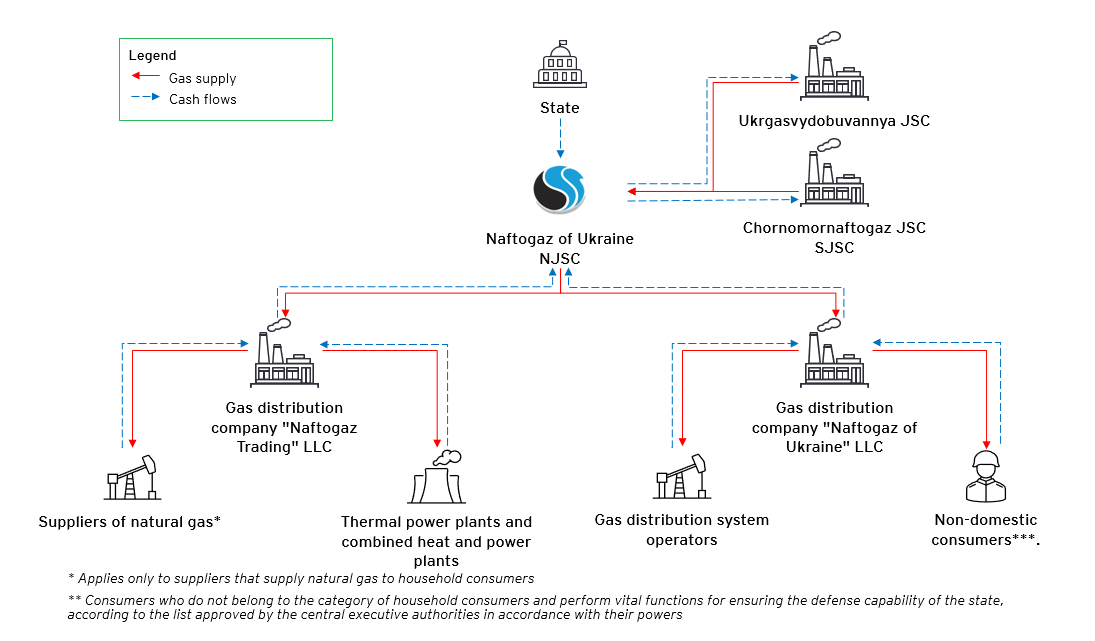 Gas supply and payments within the framework of imposing special obligations on the natural gas market
During the period from 1 January 2021 to 20 May 2021, the relevant Regulation assigned the following public service obligations (PSOs) to the following natural gas market participants:
-
►
Naftogaz of Ukraine NJSC – the obligation to purchase natural gas from natural gas market participants and sell it to heat energy producers (for specified categories of consumers);
-
►
Ukrgazvydobuvannya JSC and Chornomornaftogaz State Joint Stock Company – regarding the sale of their own-produced natural gas to Naftogaz of Ukraine NJSC under the terms established by the Regulation for the purpose of forming a natural gas resource for heat energy producers for all categories of natural gas use
As of May 20, 2021, the above-mentioned resolution became invalid, and for the period until the end of 2021, natural gas market entities were not subject to any special obligations.
Compensation by the state for expenses related to the performance of special obligations assigned to natural gas market participants
The procedure for determining compensation provided to natural gas market entities with assigned special obligations provides for a norm according to which compensation shall be provided taking into account the requirements of budget legislation and establishes a formula for calculating such compensation taking into account a number of indicators, including the volume of economically justified costs of the relevant entity.
The results of calculations made using the compensation formula are subject to verification by the State Audit Service upon submission by natural gas market entities.
Compensations to natural gas market entities with assigned special obligations shall be financed at the expense of the State Budget expenditures for the designated purpose, as provided for by the Law on the State Budget of Ukraine for the relevant period. However, neither the Law of Ukraine “On the State Budget of Ukraine for 2024”, nor the Law of Ukraine “On the State Budget of Ukraine for 2025” as of the date of preparation of this Report contain provisions on compensation for business entities that perform special obligations.
The procedure for determining the amount of compensation to natural gas market participants with special obligations requires providing compensation in compliance with the requirements of budget legislation and establishes a formula for calculating such compensation taking into account a number of indicators, including the volume of economically justified costs of the relevant entity. In 2023, the provisions and calculation formulas of the procedure were updated in connection with the establishment of new special obligations.
The results of calculations made using the compensation determination formula are subject to verification by the State Audit Service upon submission by natural gas market participants.
The compensation to natural gas market participants with assigned special obligations is financed from the state budget expenditures for the designated purpose, provided for by the Law on the State Budget of Ukraine for the relevant period. However, neither the Law of Ukraine “On the State Budget of Ukraine for 2023” nor the Law of Ukraine “On the State Budget of Ukraine for 2024” contain provisions on compensation for business entities that perform special obligations (as of the date of the preparation of this Report).
The Law of Ukraine “On the Natural Gas Market” grants natural gas market participants with assigned special obligations the right to receive compensation for economically justified costs incurred in the performance of such obligations, less the income received in the course of their performance and taking into account an allowable level of profit, in accordance with the procedure approved by the CMU. Sources of financing and the procedure for determining compensation are mandatory components of a CMU decision imposing special obligations.
In 2022, the Law of Ukraine “On the Peculiarities of Regulation of Relations in the Natural Gas Market and in the Heat Supply Sector during Martial Law and the Subsequent Restoration of Their Functioning” entered into force. The Law provides that economically justified costs incurred by natural gas market participants with assigned special obligations shall be compensated on a monthly basis.
State Budget funds allocated for financing compensation of costs incurred in the performance of special obligations, except for reimbursement of expenses incurred by natural gas market participants and entities in the heat supply sector as a result of military actions and for the purpose of preventing humanitarian crises through the repair of damaged production facilities and infrastructure, shall be used exclusively for settlements with:
► Naftogaz of Ukraine NJSC;
► Gas Supply Company Naftogaz Trading LLC;
► Gas Supply Company Naftogaz of Ukraine LLC;
► Gas Transmission System Operator of Ukraine LLC;
► Ukrtransgaz JSC.
The procedure for determining the amount of compensation provided to natural gas market participants with assigned special obligations provides for compensation from the State Budget and establishes a formula for calculating such compensation taking into account a number of indicators, including the volume of economically justified costs of the relevant entity. In 2022, the provisions and calculation formulas of the procedure were updated in connection with the establishment of new special obligations.
The Law of Ukraine “On the State Budget of Ukraine for 2022” defined sources of compensation for business entities performing special obligations, namely funds received under assistance programmes of the European Union, foreign governments, international organisations and donor institutions provided to ensure financing of measures aimed at regulating relations in the natural gas market and in the heat supply sector during martial law and the subsequent restoration of their functioning. In total, UAH 111.1 billion was allocated for compensation of costs related to the performance of special obligations.
In December 2020, the CMU approved the procedure for determining the amount of compensation provided to natural gas market participants with assigned special obligations. The procedure provides for compensation from the State Budget and establishes a formula for calculating such compensation taking into account a number of indicators, including the volume of economically justified costs of the relevant entity. The provisions of this procedure applied until 20.05.2021 (the date on which CMU Resolution No. 867 on the imposition of special obligations ceased to be effective). At the same time, the State Budget of Ukraine for 2021 did not provide for sources of compensation to natural gas market participants for the performance of special obligations.
Quasi-fiscal expenditures
On 8 April, the Cabinet of Ministers of Ukraine amended Annexes 1–3 to Resolution No. 858, “Certain issues of ensuring transparency in the extractive industries”, requiring state-owned and state-controlled companies to disclose information on their quasi-fiscal expenditures as part of the Report on payments to government.
Based on information received from Ukrgazvydobuvannya JSC and Naftogaz of Ukraine NJSC, the total amount of quasi-fiscal expenditures reported by the company in 2024 amounted to UAH 62,268,038.09 thousand.
As of 31.12.2024, the Company does not supply gas to consumers within the meaning of the Law of Ukraine “On the Natural Gas Market” and other regulatory legal acts regulating activities on the natural gas market of Ukraine, however, it ensures the formation of a natural gas resource for Gas Supply Company Naftogaz Trading LLC, which, in turn, supplies natural gas.
The request for quasi-fiscal operations was addressed to all material reporting extractive companies. According to information provided by Naftogaz of Ukraine NJSC, the company’s total quasi-fiscal expenditures in 2023 amounted to UAH 17,651,377.86 thousand. This amount represents the accumulation of accounts receivable of Naftogaz of Ukraine NJSC, Gas Supply Company Naftogaz of Ukraine LLC, and Gas Supply Company Naftogaz Trading LLC arising from the sale of natural gas to households, public sector institutions, entities supporting national defence, and district heating companies.
As of 31.12.2023, the company does not supply gas to consumers within the meaning of the Law of Ukraine “On the Natural Gas Market” and other legal acts regulating operations in the natural gas market of Ukraine. However, the company provides natural gas resource to Gas Supply Company Naftogaz Trading LLC, which, in turn, supplies natural gas to consumers.
The request for quasi-fiscal operations was addressed to all material reporting extractive companies. However, no material types of quasi-fiscal operations were identified in the extractive sector other than in the natural gas industry.
According to information provided by Naftogaz of Ukraine NJSC, the company’s total quasi-fiscal expenditures in 2022 amounted to UAH 23,241,417.65 thousand. This amount represents the accumulation of accounts receivable of Naftogaz of Ukraine NJSC, Gas Supply Company Naftogaz of Ukraine LLC, and Gas Supply Company Naftogaz Trading LLC arising from the sale of natural gas to households, public sector institutions, entities supporting national defence, and district heating companies.
By the decision of the EITI MSG, based on the available information and the recommendations of the Independent Administrator, quasi-fiscal operations in the natural gas industry of Ukraine were identified as the only material quasi-fiscal operations to be disclosed in the EITI Report (Minutes of the EITI MSG meeting dated 22 November 2019). No other material types of quasi-fiscal operations were identified. For the purposes of preparing the EITI Report 2020, the request regarding quasi-fiscal operations was addressed to all material extractive enterprises in the state sector of the economy (Minutes of the EITI MSG meeting dated 1 October 2021).
According to the Law of Ukraine “On the Natural Gas Market”, the functioning of wholesale and retail natural gas markets is based on the principle of free pricing. An exception applies where special obligations are imposed on market participants in order to ensure public interests in the process of the functioning of the natural gas market, as provided for in Article 11 of the Law of Ukraine “On the Natural Gas Market”.
According to information provided by Naftogaz of Ukraine NJSC, the company’s total quasi-fiscal expenditures in 2021 amounted to UAH 27,694,306.00 thousand. This amount represents accumulated accounts receivable arising from the sale of natural gas to households and district heating companies as of 31.12.2020. No quasi-fiscal operations were carried out by other reporting natural gas production companies during 2020.
According to Naftogaz of Ukraine NJSC, the company's total quasi-fiscal expenditures amounted to UAH 37,158,778 thousand in 2020. This amount is the accumulated receivables for the sale of natural gas to the population and heat energy enterprises as of December 31, 2020.
According to the response of Naftogaz of Ukraine NJSC to the request, in 2019 the total quasi fiscal expenditures amounted to UAH 43,128,737.43 thousand
According to the Naftogaz of Ukraine NJSC, the total quasi-fiscal expenditures amounted to UAH 38,871,381 thousand
Quasi-fiscal operations were not conducted by other material reporting gas companies during 2018-2020.
Payments for social and charitable purposes
Payments for social and charitable purposes
Loading...
According to Requirement 6.1 of the EITI Standard, extractive companies are to disclose their material mandatory social and environmental expenditures. Where material mandatory payments are contractually mandated, disclosure of the relevant contracts is also expected.
-
►
Where material social expenditures by companies are mandated by law or a contract with a government regulating investment in the extractive sector, such agreements and transactions are to be disclosed (including where benefits are provided in kind).
If the beneficiary of such mandatory social expenditure is a third party (i.e. not a government agency), the name and position, as well as gender-disaggregated data on the beneficiaries, if available, is to be disclosed.
-
►
If material environmental payments are provided for in a contract with the state that is related to the extraction of minerals, such contracts and information on the payments should also be disclosed.
-
►
f voluntary social or environmental payments are material, disaggregated disclosure of gender-disaggregated data on the beneficiaries of such expenditure and transfers is encouraged, if available (with the possibility of unilateral disclosure).
Mandatory social and environmental payments required by law
In 2023 - 2024, the main social and environmental payments of extractive companies, the payment of which is mandatory according to the Ukrainian law, were the environmental tax and the Unified Social Contribution.
Reimbursement of actual costs for the payment and delivery of pensions granted on preferential terms.
Extractive enterprises paid the Pension Fund of Ukraine reimbursement for the costs of payment and delivery of preferential pensions in accordance with the Law of Ukraine "On Compulsory State Pension Insurance".
-
►
Preferential pensions are assigned to employees employed full-time in underground work or in other work with especially harmful and especially difficult working conditions according to List No. 1 (List No. 1) and in other work with harmful and difficult working conditions according to List No. 2 (List No. 2) – both approved by the CMU. Such persons have the right to early retirement before reaching the standard retirement age.
-
►
From the moment the person retires with a preferential pension until he/she reaches standard retirement age, the enterprise is obliged to finance his/her pension payments. While the enterprises cannot pay the preferential pensions through professional and corporate funds, they are paid by the Pension Fund of Ukraine and subject to reimbursement.
-
►
Preferential pensions are paid by the Pension Fund, which subsequently applies to the enterprises for reimbursement of the expenses incurred that are related with payment and delivery of pensions to preferential categories of employees.
-
►
The enterprises are to pay the Pension Fund the monthly amount of actual expenses related with the payment and delivery of pensions assigned on preferential terms to the Pension Fund by the 25th of each month. The total non-disaggregated amount of compensation received from the companies was presented by the Pension Fund of Ukraine in the Report on results of work done and budget execution.
In the funds from the companies do not fully cover the expenditures related with paying and delivering such pensions, the lacking funds are financed from the general fund of the State Budget of Ukraine. The specified payments are not tax payments.
According to the PFU as of January 1, 2025 the total of 106,349 persons were to receive preferential pensions from the material reporting companies, including 27,774 women.
The current EITI Law does not provide for the disclosure of such information, therefore, the information was not requested from the material reporting companies. The debt to the Pension Fund as of 01.01.2024 is UAH 905.89 million.
Free provision of coal to employees and privileged categories of citizens for household needs
In 2023–2024, coal mining companies provided free coal to employees and privileged categories of citizens for household needs, which may be considered as a mandatory social payment in kind. According to Article 43 of the Mining Law, the following categories of persons are entitled to receive such coal:
-
►
the workers engaged in coal mining (processing) and employed by the coal-mining enterprises according to the list of professions approved by the Cabinet of Ministers of Ukraine
-
►
the pensioners who have worked at coal mining (processing) enterprises, coal-mining enterprises: in underground work – for not less than 10 years for men and not less than 7 years 6 months – for women; in work related to underground conditions – for not less than 15 years for men and not less than 12 years 6 months for women; in work on the technological line on the surface in operating mines or mines under construction, open-pit mines, enrichment and briquette factories – for not less than 20 years for men and not less than 15 years for women;
-
►
the pensioners who have worked at coal mining (processing) enterprises, coal-mining enterprises and have a general preferential length of service in underground work and/or the work related to underground conditions, and/or work on the technological line on the surface at operating mines or mines under construction, open-pit mines, enrichment and briquette factories – for at least 20 years for men and at least 15 years for women;
-
►
disabled persons and war and labor veterans, persons awarded the Miner's Glory or Miner's Valor three degrees, persons whose disability occurred as a result of a general illness, if they used this right before the onset of disability;
-
►
family members (widows) of workers who died at coal mining (processing) enterprises, who are entitled to a pension due to the loss of a breadwinner, as well as deceased pensioners who had such a right during their lifetime.
-
►
In accordance with paragraph 10.12.3 of the Sectoral Agreement,[1] which is available in the public domain, free coal for workers and pensioners of the coal mining industry shall be provided at the rate of 5.9 tonnes per year per house or apartment
-
►
The persons who are entitled to free coal provision and work at brown coal mining (processing) enterprises may be provided with peat briquettes instead of coal.
The current law does not provide for a direct obligation for business entities to disclose such information. According to the information received by the Independent Administrator from the Ministry of Energy of Ukraine regarding the provision of household fuel to the employees of the state-owned mines, 7,904 coal recipients received coal free of charge in 2024. The volume of coal provided free of charge to the employees of coal mining enterprises is not a material payment in 2024.
Given that the Ministry of Energy collects information only from the state-owned mines, the Independent Administrator sent requests to other material reporting companies in order to obtain data on the provision of free coal to the coal recipients. The only company that provided information is DTEK Pavlohradcoal PrJSC. The price of one ton of coal (excluding VAT) was UAH 6,250 in the reporting period. The total volume of free coal provided was 60,393.20 tons, which was distributed among 12,575 coal recipients. The estimated cost of the volume is UAH 377,457.50 thousand (excluding VAT).
Also, as part of the report on payments in favour of the state, Colliery Group Pokrovs'ke PrJSC disclosed information on the provision of household coal to the worth of UAH 40,531.70 thousand.
In the reporting period, the reporting coal mining companies also provided preferential categories of the population with free coal in accordance with current legislation.
The total need of preferential categories of the population for household fuel in 2024 was 6,812.9 tons of coal for 1,238 people. However, during the year, only 1,054 people were provided with fuel, i.e. 85.1% of the need. Also, the distribution of fuel between preferential categories did not reach the planned amount - it reached 5,646.4 tons of coal, which is 82.9% of the need. Based on the information on providing preferential categories of beneficiaries with coal for household fuel for 2024.
Since the beginning of the year, 52,347.8 tons of coal for 10,824 people* were exported by coal-mining enterprises to provide workers and privileged categories with free fuel.
The total need of privileged categories of the population to provide household fuel in 2023 was 6,013.5 tons of coal for 1,102 persons*.
*Information provided to the Ministry of Energy at the request of the Independent Administrator, and includes only information about state-owned enterprises that are subordinate to the Ministry of Energy.
Social and environmental payments stipulated in contracts
PSAs may provide for the investor’s obligation to make social or environmental payments.
The extracts and essential terms of a number of PSAs, which are posted on the Ministry of Energy’s website, provide for the possibility of making infrastructure and social payments in favour of the state or local communities. The essential terms of the PSAs specify general provisions on financing social investments and infrastructure modernization. Obligations to make environmental payments do not directly follow from the publicly available essential terms of the PSA.
-
►
The extracts and essential terms of the PSAs posted on the Ministry of Energy website do not contain lists of recipients of such payments or clear terms of their payment, which does not allow establishing the recipient gender. In most cases, there is also no information on the amounts, which does not allow us to draw a conclusion about their materiality. All current PSAs were concluded before 2022, therefore the law does not require the publication of the full texts of the agreements.
At the same time, additional agreements to the PSAs for the Hrunivska and Okhtyrska sites, which were concluded in April 2024, are not published on the Ministry of Energy website.
-
►
The SGS provided information on social, environmental and infrastructure payments according to the investor reports for 2024, which shows that social or infrastructure payments were made only for two PSAs – for Zinkivska and Uhnivska sites, and that the amounts paid were below the materiality threshold approved by the EITI MSG for 2024.
-
►
SGS provided information on social, environmental and infrastructure payments according to the investor reports 2023, which shows that social or infrastructure payments were made only under two PSAs – Zinkivska and Ugnivska agreements, and that the amounts paid were below the materiality threshold approved by the EITI MSG for 2023. The SGS also noted that social payments for the Yuzivska PSA had not been made since 2022.
Charitable social and environmental payments stipulated in other agreements
As part of the Report on payments in favour of the state, 5 material reporting companies disclosed information on the existing contractual obligations for social and environmental payments in the amount of UAH 1,515.41 million. The payments were below the materiality threshold approved by the EITI MSG for 2024.
Social, environmental and infrastructure payments provided for in the conditions of issuing special permits for subsoil use
In 2024, the law did not provide for mandatory contributions by extractive companies to infrastructure development or social payments as conditions for obtaining special permits for subsoil use.
At the same time, a number of material reporting companies made social, environmental or infrastructure payments in 2024 in accordance with agreements concluded to fulfil the conditions for issuing special permits issued before 2015.
Until 2015, the granting of special permits for subsoil use required approval from the relevant regional councils, and decisions on approval of the issuance of special permits could contain obligations to fulfil certain social and infrastructure obligations.
Natural Resources PrJSC and Eastern Geological Union LLC received approval to obtain a special permit from the Poltava Regional Council in 2011 and 2014. As part of the agreements, the regional council obliged both companies to conclude annually, during the term of the special permit, agreements with local authorities for the construction, reconstruction, repair, and maintenance on a shared basis of social infrastructure facilities, local roads, and environmental protection measures.
In 2023, the legislation did not require extractive companies to make mandatory infrastructure development contributions as a condition for obtaining special permits for subsoil use.
Voluntary social expenditures and environmental payments
The EITI Report 2024 presents data on 59 material reporting companies that submitted the relevant information via the EITI online platform. The current reporting form requires the companies to provide the total expenses without disaggregation by social and environmental areas. Therefore, the Independent Administrator determined the following key categories of the payments:
-
►
charity
-
►
education and science, support for educational institutions
-
►
improvement of settlements
-
►
support for local communities
-
►
healthcare, support for medical institutions
-
►
sports
-
►
environmental activities
The first 6 categories are subtypes of social expenditures, and the category of environmental payment is a separate one. In addition, due to the russian full-scale invasion of the territory of Ukraine in 2022, a significant amount of voluntary expenditures of extractive companies were directed to the needs of military formations and to assist citizens affected by the hostilities. For this reason, the Independent Administrator has identified a separate category of expenses “Assistance to Defenders and Strengthening Ukraine’s Defence Capability”. This additional category in 2024 includes purchases of vehicles and fuel, personal protective equipment, tactical equipment and other purchases to satisfy the needs of the defenders of Ukraine. Also, part of the expenses of the material reporting companies were directed to support internally displaced persons, military families and humanitarian aid. These expense items are combined into the “Charity” category.
Overall, 19 material reporting submitted information on their social expenditures, including 12 companies that belong to oil and gas industry, 6 companies – to metal ore industry, and 1 company to the coal industry.
The largest category of expenditures is Assistance to Defenders – 81.97% of the total funds voluntarily spent by material companies were for the needs of the Armed Forces of Ukraine in 2024. The total amount of the reported payments is UAH 841,108.08.
The EITI Report 2024 presents data on 59 material reporting companies that submitted the relevant information via the EITI online platform. The current reporting form requires the companies to provide the total expenses without disaggregation by social and environmental areas. Therefore, the Independent Administrator determined the following key categories of the payments:
| Target area of expenditures | Oil and gas | Iron ores | Coal | Total | Share % |
|---|---|---|---|---|---|
| Assistance to Defenders | 453,054.89 | 92,223.99 | 295,829.20 | 841,108.08 | 81.97% |
| Charity | 64,363.08 | 47,838.38 | 9,618.10 | 121,819.56 | 11.87% |
| Healthcare, support for medical institutions. | 24,327.10 | 199,66 | - | 24,526.76 | 2.39% |
| Support for local communities | 10,935.33 | 2,530.88 | 5,600,00 | 19,066.21 | 1.86% |
| Education and science, support for educational institutions | 9,810.25 | - | - | 9,810.25 | 0.96% |
| Improvement of settlements | 5,974.39 | - | - | 5,974.39 | 0.58% |
| Sports | 3,483.17 | - | - | 3,483.17 | 0.34% |
| Environmental activities | 376.18 | - | - | 376.18 | 0.04% |
| Total: | 572,324.39 | 142,792.91 | 311,047.30 | 1,026,164.60 | 100% |
The EITI Report 2023 presents data on 59 material reporting companies that submitted the relevant information via the EITI online platform. The current reporting form requires the companies to provide the total expenses without disaggregation by social and environmental areas. Therefore, the Independent Administrator determined the following key categories of the payments:
-
►
charity
-
►
education and science, support for educational institutions
-
►
improvement of settlements
-
►
support for local communities
-
►
healthcare, support for medical institutions
-
►
sports
-
►
environmental activities
The first 6 categories are considered subtypes of social expenses, and the last category is deemed to be environmental payments. In addition, due to the full-scale russian invasion of the territory of Ukraine in 2022, extractive companies spent a significant amount of their voluntary expenses to satisfy the needs of Ukrainian military formations and to assist Ukrainians who suffered as a result of hostilities. For this reason, the Independent Administrator has identified a separate category of expenses “Assistance to Defenders and Strengthening the Defense Capability of Ukraine”. In 2023, this additional category includes purchases of vehicles and fuel, personal protective equipment, tactical equipment and other purchases aimed at the needs of defenders. Also, part of the expenses of the reporting extractive companies were directed to support internally displaced persons, military families and humanitarian aid. All these expenses are combined into the category “Charity”.
23 material reporting companies submitted information on social expenditures, including 6 iron ore mining companies, 1 coal mining company, and the rest – oil and natural gas extraction companies.
The item "Assistance to Defenders" is the largest one in the category – it accounted for 42.18% of all funds voluntarily spent by material companies for social needs in 2023. The total amount of the reported payments is UAH 2,579,186.54.
| Target area of expenditures | Oil and gas | Iron ores | Coal | Total | Share % |
|---|---|---|---|---|---|
| Assistance to Defenders | 74,030.95 | 103,442.00 | 910,396.29 | 1,087,869.24 | 42.18% |
| Charity | 134,072.34 | 805,792.92 | - | 939,865.26 | 36.44% |
| Support for local communities | 18,555.30 | 496,538.99 | - | 515,094.29 | 19.97% |
| Improvement of public spaces | 14,619.35 | 825.49 | - | 15,444.84 | 0.60% |
| Healthcare, support for medical institutions | 5,320.50 | 5,358.00 | - | 10,678.50 | 0.41% |
| Environmental measures | 4,023.68 | - | - | 4,023.68 | 0.16% |
| Education and science, support for educational institutions | 3,509.20 | 290.39 | - | 3,799.59 | 0.15% |
| Sports | 2,411.14 | - | - | 2,411.14 | 0.09% |
| Total | 256,542.46 | 1,412 247.79 | 910,396.29 | 2,579,186.54 | 100% |
The 2022 EITI Report presents data from 65 material reporting companies that submitted the relevant information through the UAEITI Portal. Given that the current reporting template collects expenditure data without distinguishing between social and environmental spending, the Independent Administrator has classified these expenditures into the following categories:
-
►
charity
-
►
education and science, support for educational institutions
-
►
improvement of settlements
-
►
support for local communities
-
►
healthcare, support for medical institutions
-
►
sports
-
►
environmental activities
-
►
Assistance to Defenders and Strengthening the Defense Capability of Ukraine
The first 6 categories are considered subtypes of payments for social purposes, and the category of environmental expenditures is highlighted separately.
In addition, in connection with a full-scale invasion of the territory of Ukraine in 2022, a significant amount of voluntary spending by mining companies was directed to the needs of military formations and to help citizens affected by hostilities. For this reason, the Independent Administrator has singled out the expenditure category "Assistance to defenders and strengthening the defense capability of Ukraine". This additional category in 2022 includes purchases of vehicles and fuel, personal protective equipment, tactical equipment and other purchases aimed at the needs of defenders.
Also, part of the expenses of accountable companies in the extractive industry were directed to the support of internally displaced persons, military families and humanitarian aid. The specified expenditure items are combined into the "Charity" category.
Among the material companies, 19 companies submitted information on spending for social purposes, six of which belong to the iron ore mining industry, one each to the titanium ore and hard coal mining industries, and the rest to the oil and natural gas mining industry.
| Target area of expenditures | Oil and gas | Iron ores | Coal | Total |
|---|---|---|---|---|
| Charity | 3 802,24 | 436 159,28 | 17 577,76 | 457 539,28 |
| Education and science, support for educational institutions | 1 055,44 | 843,00 | - | 1 898,44 |
| Improvement of settlements | 1 057,73 | 1 656,56 | 401 222,48 | 403 936,77 |
| Support for local communities | 28 336,53 | 206 707,29 | - | 235 043,82 |
| Healthcare, support for medical institutions. | 3 851,84 | 258,00 | - | 4 109.84 |
| Sports | 2 139,99 | - | 4 890,30 | 7 030,29 |
| Environmental activities | - | - | - | - |
| Assistance to Defenders | 1 069 789,42 | 453 719,51 | 3 455,30 | 1 526 964,23 |
| Total | 1 110 033,19 | 1 099 343,64 | 427 145,84 | 2 636 522,66 |
The 2021 EITI Report presents data of material reporting companies, the total volume of funds directed to social and environmental goals amounted to UAH 44,524.02 million. In terms of target directions, the largest share of social and environmental costs of accountable companies was attributed to the category "Education and science, support of educational institutions" - UAH 13,134.07 million, or 29.50% of total payments.
In terms of administrative regions, the largest part of the funds was directed to the support of communities in the Poltava region - UAH 25,572.71 million, or 57.44% of the total payments.
| Target area of expenditures | Oil and gas | Coal | Total |
|---|---|---|---|
| Education and science, support for educational institutions | 13,132,424.55 | 1,642.00 | 13,134,066.55 |
| Charity | 10,221,822.23 | 35,200.00 | 10,257,022.23 |
| Support for local communities | 9,705,293.44 | 24,200.00 | 9,729,493.44 |
| Healthcare, support for medical institutions. | 6,162,617.95 | 3,940.00 | 6,166,557.95 |
| Sports | 4,285,252.54 | 4,000.00 | 4,289,252.54 |
| Environmental activities | 947,624.83 | 0 | 947,624.83 |
| Total | 44,455,035.54 | 68,982.00 | 44,524,017.54 |
Of the 54 material reporting companies for EITI Report 2020, 24 material companies provided information on spending on social and charitable purposes, of which 14 companies operate in the field of oil and natural gas production, 8 companies in the field of iron ore mining, and 2 companies in the field of hard coal mining. According to the data of the companies, their total payments for social and charitable purposes in 2020 amounted to UAH 1,152.38 million.
In terms of target areas, the largest share of social and charitable expenses of accountable companies was assigned to the category "Health care, support of medical institutions" - UAH 663.94 million, or 57.61% aggregate payments.
In order to disclose in the EITI Report for 2019 information on the expenditures of mining companies for social and charitable purposes, the data of the accountable companies, provided by them during the survey, was collected. The division of such costs by the following areas was carried out by the independent administrator:
-
►
Support for local communities
-
►
Healthcare, support for medical institutions
-
►
Education and science, support for educational institutions
-
►
Other
Information on expenditures for social and charitable purposes was provided by 19 material reporting companies, of which 11 are active in the field of oil and natural gas production, 6 companies in the field of iron ore production, and 2 companies in the field of hard coal production. According to the data of these companies, their total payments for social and charitable purposes in 2019 amounted to UAH 257,829.09 thousand.
In terms of target areas, the largest share of social and charitable expenses of accountable companies was assigned to the category "Support of local communities" - UAH 203,446.16 thousand, or 78.91%. Expenditures in the spheres of "Health care" and "Education and science" amounted to UAH 13,983.68 thousand (5.42%) and UAH 18,844.39 thousand (7.31%), respectively.
In order to disclose in the EITI Report for 2018 information about the expenditures of material reporting companies in the extractive industry for social and charitable purposes, data provided by them during the survey was collected. The distribution of these payments according to their target directions was carried out by the Independent Administrator, as the reporting forms approved by the CMU do not provide for such a division. The following areas were highlighted:
-
►
Support for local communities
-
►
Healthcare, support for medical institutions.
-
►
Environmental activities
-
►
Education and science, support for educational institutions
-
►
Other
Information on expenses for social and charitable purposes was provided by 18 material reporting companies, of which 10 were active in the field of oil and natural gas extraction, 6 companies - in the field of iron ore extraction, and 2 companies - in the field of hard coal extraction. Total payments for social and charitable purposes in 2018, according to the data of the indicated companies, amounted to UAH 448,125.91 thousand.
In terms of target directions, in 2018 more than half of the social and charitable expenses of material reporting companies in the extractive industries were assigned to the category "Support of local communities" - UAH 355,317.81 thousand, or 79.29%.