


What is systematic disclosure?
Transparency in the extractive industry should not be limited only to the EITI Report. Rather, it must become an integral part of how governments manage the extractive sector and how companies manage their operations.
Requirement 4.9 of the 2023 EITI Standard establishes systematic disclosure as the default expectation for EITI reporting in line with open data policy. In cases where transparency is widespread and data quality is sufficient, countries may apply to the EITI Board for approval to systematically disclose data without payment reconciliation.
Requirement 7.2 on open data supports this approach by requiring countries to:
-
►
Publish data in open formats;
-
►
Ensure data is machine-readable;
-
►
Complete the Summary Data Template.
Systematic disclosure means that EITI requirements are met through regular and publicly accessible reporting by companies and the government, rather than only through traditional EITI Reports. This may include:
-
►
Public financial reporting;
-
►
Annual reports of companies or government agencies;
-
►
Information portals and databases;
-
►
Open data and freedom of information initiatives.
Mainstreaming is the process of implementing this goal, which may include interim measures, pilot projects, and other capacity building activities. It is important to emphasize that the procedure does not change the EITI requirements for disclosure:
-
►
The same information in the same scope and with the same level of detail;
-
►
Preservation of oversight by the multi-stakeholder group (EITI MSG);
-
►
Ensuring the completeness and reliability of data.
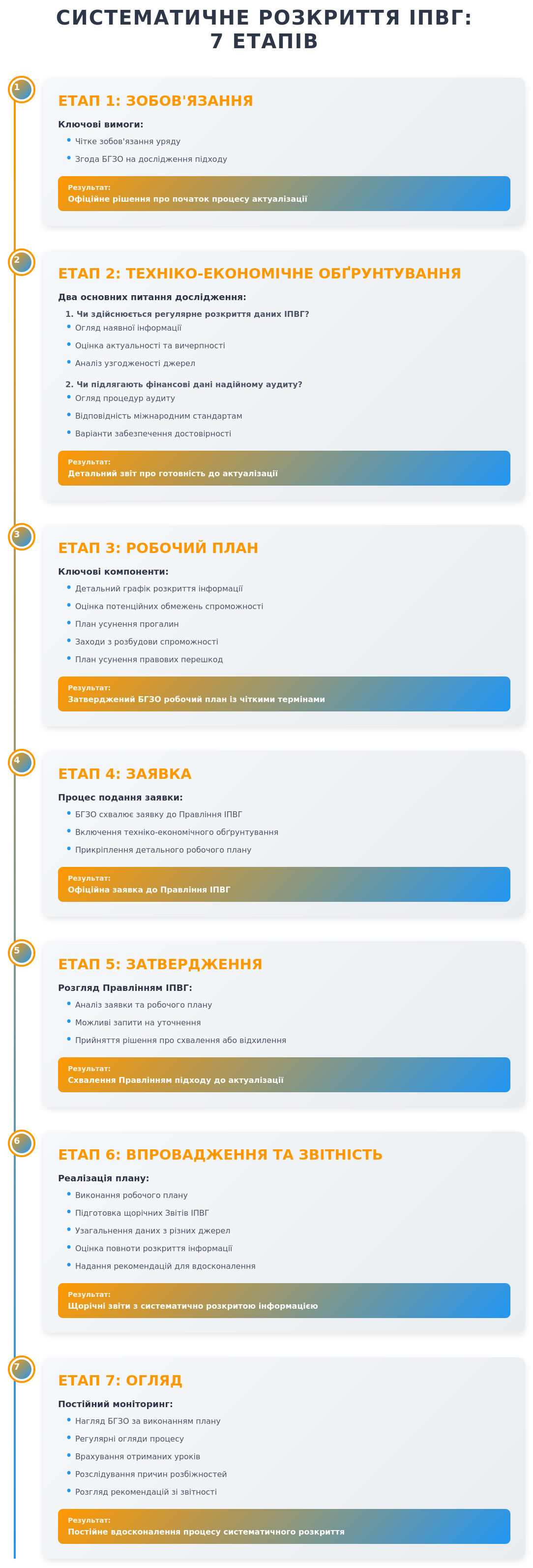
Mapping Tool
The Mapping Tool is an Excel file that contains a list of all required disclosures according to the EITI Standard. It is used to assess which disclosures are already publicly available outside of the EITI process.
More details via the link https://eiti.org/documents/systematic-disclosure-toolkit
Advantages of Systematic Disclosure
For Governments:
-
►
Integration into existing systems: transparency becomes part of routine processes;
-
►
Reduced burden: no need to prepare separate EITI reports;
-
►
Data timeliness: information is available in real-time;
-
►
Improved governance: systematization of data on the extractive sector.
For Companies:
-
►
Simplified reporting: use of existing corporate systems;
-
►
Cost reduction: less duplication of information;
-
►
Increased trust: regular and predictable data disclosure.
For Civil Society:
-
►
Constant access: information is always available, not just once a year
-
►
Usability: data in various formats for analysis;
-
►
Monitoring capability: tracking changes in real-time.
Challenges of Systematic Disclosure
Technical Capacity:
-
►
Challenge: insufficient capacity of state institutions
-
►
Solution: phased implementation with technical support
Data Quality:
-
►
Challenge: inconsistency of data between different sources
-
►
Solution: standardization of reporting formats and procedures
Legal Constraints:
-
►
Challenge: legislative barriers to information disclosure
-
►
Solution: inclusion of EITI requirements in national legislation
Stakeholder Coordination:
-
►
Challenge: need for coordination among many institutions
-
►
Solution: clear division of responsibilities and regular communication
Ukraine's Experience
The key systematic disclosure instrument in Ukraine is the Electronic System for EITI Analysis and Reporting (Extractive Industry Data Portal of Ukraine) - eiti.gov.ua.
The EITI Portal is updated annually and integrated with other state resources, disclosing more and more information about the extractive sector to comply with the requirements of the EITI Standard and best global transparency practices.
Data disclosed by Ukraine through the EITI Portal:
-
►
Legal framework and fiscal regime;
-
►
Allocation of special permits for subsoil use;
-
►
Register of special permits (licenses) and contracts;
-
►
Beneficial ownership data;
-
►
The state's role in the extractive sector;
-
►
Data on exploration, reserves, and extraction of mineral resources;
-
►
Full disclosure of taxes and revenues;
-
►
Транспортні доходи та інші ключові аспекти.
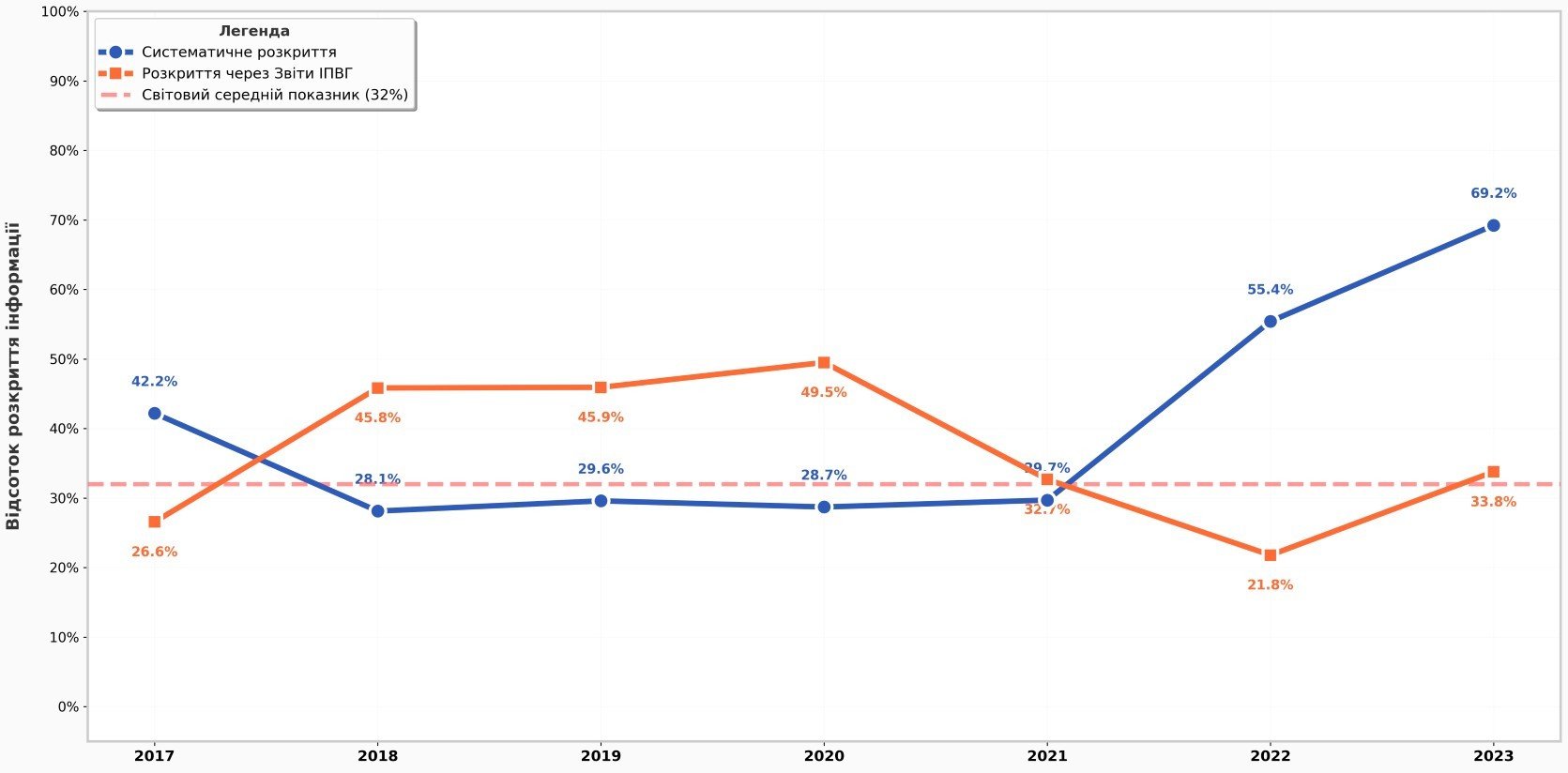
Dynamics of Systematic Disclosure in Ukraine
International Experience
The EITI International Secretariat website regularly tracks country-level progress on systematic disclosure of extractive sector data using a dynamic tool that allows users to monitor how countries are implementing specific disclosure requirements of the EITI Standard.
Dashboard
Loading...
State Web Portal for the Citizen's Budget
One of the best examples of systematic disclosure is the State Web Portal for the Citizen's Budget - Open Budget.
Open Budget (openbudget.gov.ua) is the official state web portal of Ukraine that ensures full openness of public finance data, including the State and local budgets.
The portal was created by the Ministry of Finance of Ukraine in 2018 in response to public demand for transparency and in execution of the Concept of the Information and Analytical System (IAS) "Transparent Budget". The IAS supports the principles of Ukraine's open government and:
-
►
Meets the highest standards of transparency, taking into account the recommendations of the World Bank, IMF, and International Budget Partnership;
-
►
Ensures transparency of budget processes and procedures at both state and local levels.
Open Budget is a key component of the Unified Open Data Platform in the field of public finance – E-data (edata.gov.ua).
The main purpose of the Open Budget portal is to inform the general public about Ukraine's budget policy in the most accessible and understandable form. The portal's goal:
-
►
Transparency: To ensure every taxpayer understands exactly what state and local funds are spent on;
-
►
Control: To provide citizens with a tool for public control over the use of budget resources at all levels.
The Open Budget portal offers a full set of data and analysis tools:
| Тип бюджету | Доступна інформація | Особливості |
|---|---|---|
| Державний бюджет | Виконання (поточні надходження та витрати), повна структура за доходами та видатками. | Можливість аналізувати макрофінансову політику країни. |
| Місцеві бюджети | Дані по 9 603 місцевих бюджетах України. Доходи та видатки кожного окремого бюджету. | Громадяни можуть контролювати фінанси на рівні своєї області, міста, села чи селища. |
Visualization and Analytics
For better comprehension of complex financial data, the portal offers interactive tools:
-
►
Interactive widgets: Data is displayed in the form of graphs, charts, and maps, allowing for quick assessment of the situation;
-
►
Drill-down: You can interact with the visualizations (click on elements) to get in-depth information on a specific expenditure or revenue item.
Implementation of the Budget Widget for Local Government Websites
The Open Budget portal offers a simple mechanism for integrating budget data visualizations directly onto the official websites of local self-government bodies (LSGB). This allows municipalities to instantly increase the transparency of financial activities for their community.
The budget widget is a small interactive element (frame, iframe) that is embedded on the LSGB's web page. It automatically displays up-to-date data on the revenues and expenditures of a specific local budget, using the visualization from the Open Budget portal.
Implementation Process (Steps for LSGBs)
More details via the link https://edata.gov.ua/widget-openbudget.html
Upon clicking the widget, one can see not only the overall budget structure but also the contribution of each type of tax, including the subsoil use royalty.
Advantages for LSGBs:
-
►
Automatic update: Data is updated automatically every month in sync with the Open Budget portal (source – SSSU). LSGBs do not need to manually upload or update financial reports.
-
►
Increased trust: Real-time demonstration of financial transparency increases citizens' trust in local authorities;
-
►
Ease of use: Citizens can quickly access key budget information without leaving the website of their territorial community.
Methodology for Determining the Level of Systematic Disclosure Based on EITI Summary Data
The level of systematic disclosure is determined based on the EITI Summary Data, which countries prepare annually after the approval of the regular EITI Report. This file contains a Disclosure Checklist tab, where compliance with the disclosure requirements of the EITI Standard is assessed. The Checklist covers 24 requirements of the Standard, containing about 144 clarifying questions. For each point, the country indicates the method of information disclosure, choosing one of four options:
-
►
Systematically disclosed — information is available in open sources and regularly updated;
-
►
EITI Report — information is disclosed only in the EITI Report;
-
►
Not available — information should be available, but the country does not publish it;
-
►
Not applicable — the requirement does not apply to the specific country.
The systematic disclosure indicator is automatically calculated using an Excel formula as the proportion of items marked as Systematically disclosed in the total number of responses in the Disclosure Checklist.
Systematic Disclosure Indicator in Ukraine
згідно даних Міжнародного секретаріату, станом на листопад 2025 року
| Модуль | Показник | Рівень розкриття |
|---|---|---|
| Licenses | Contract and license allocations | Systematically disclosed |
| Licenses | Contracts disclosure | Systematically disclosed |
| Beneficial ownership | Government policy on beneficial ownership | Systematically disclosed |
| Revenue collection | Data quality and assurance | Systematically disclosed |
| Legal and fiscal framework | Legal framework and fiscal regime | Systematically disclosed |
| Revenue allocation | Revenue management and expenditures | Systematically disclosed |
| Subnational contribution | Subnational transfers | Systematically disclosed |
| State participation & SOEs | State participation reporting | Systematically disclosed |
| Production and exports | Production disclosure | EITI Report |
| Revenue collection | Subnational payments | EITI Report |
A detailed table reflecting the level of systematic disclosure information derived from EITI Summary Data for Ukraine will be added to the EITI Portal soon.
Extractive industry data