


Employees
Workers
Loading...
Before the full-scale russian invasion of Ukraine, the EITI Reports provided data on the average number of full-time employees (including by gender) in the extractive industries, obtained from the State Statistics Service in response to a request from the Independent Administrator. Obtaining the specified data for 2024 turned out to be impossible in accordance with the Law of Ukraine “On Protection of the Interests of Subjects of Reporting and Other Documents during the Period of Martial Law or a State of War”, since individuals, individual entrepreneurs, legal entities have the right not to submit statistical reporting during martial law. That is why the state statistics bodies were unable to generate objective statistical information.
According to the reports actually submitted by the enterprises and the reassessments of the State Statistics Service indicators, the number of employees employed by economic entities in the extractive industry and quarry development amounted to 138 thousand people, or 1.83% of the total number of employed people in Ukraine. Also, 40 thousand people worked in the metal ore mining industry, of which 28 thousand people were in the iron ore mining industry. 39 thousand people worked for business entities in the crude oil and natural gas mining industry, which is 0.51% of the employees employed by business entities in Ukraine. 16 thousand people worked in the stone, sand and clay mining industry (0.21% of the total employees in Ukraine). The information will be clarified after the statistical data are updated.
Before the full-scale russian invasion, the EITI Reports provided data on the average number of full-time employees (including by gender) in the extractive industries, obtained from the State Statistics Service in response to a request from the Independent Administrator. Obtaining the specified data for 2023 turned out to be impossible due to the Law of Ukraine “On Protection of the Interests of Subjects of Reporting and Other Documents during the Period of Martial Law or a State of War”, since individuals, individual entrepreneurs, and legal entities have the right not to submit statistical reports during martial law. This made it impossible for state statistics bodies to form objective statistical information.
According to the reports submitted by the enterprises and the reassessments of the indicators calculated by the State Statistics Service, the number of employees in the extractive industry and quarry development business entities was 147 thousand people, which is 1.95% of the total number of employees in Ukraine. Of them, 44 thousand people were employed in the metal ores mining industry, including 31 thousand people – in the iron ore mining industry. 38 thousand people worked in the crude oil and natural gas extractive business entities, which is 0.50% of the employees of business entities in Ukraine. 17 thousand people were employed in the stone, sand and clay mining industry (0.22% of the employees of Ukraine).
Obtaining data on the average number of full-time employees (including by gender) in the extractive industries from the State Statistics Service for 2022 turned out to be impossible due to the Law of Ukraine “On Protection of the Interests of Subjects of Reporting and Other Documents during the Period of Martial Law or a State of War”, since individuals, individual entrepreneurs and legal entities have the right not to submit statistical reports during martial law. This made it impossible for state statistics bodies to form objective statistical information.
Thus, the state statistics bodies suspended the publication of statistical information, including information on the average number of full-time employees in total and by gender, during the period of martial law and for three months after its termination. In view of the above, a comparison of the data presented in this section with the data published in previous EITI Reports is not appropriate.
According to the reports submitted by the companies and the reassessments of the indicators calculated by the State Statistics Service, the number of employees employed by business entities in the extractive industry and quarry development amounted to 169 thousand people in 2022, which is 2.23% of the total employment in Ukraine. At the same time, 55 thousand people were employed in the metal ore mining industry, including 38 thousand people in the iron ore mining industry. A total of 39 thousand people worked in the crude oil and natural gas extractive industry, which is 0.51% of the employees employed by business entities in Ukraine.
According to the reports submitted by the companies and the reassessments of the indicators calculated by the State Statistics Service, the number of employees employed by business entities in the extractive industry and quarry development amounted to 169 thousand people in 2022, which is 2.23% of the total employment in Ukraine. At the same time, 55 thousand people were employed in the metal ore mining industry, including 38 thousand people in the iron ore mining industry. A total of 39 thousand people worked in the crude oil and natural gas extractive industry, which is 0.51% of the employees employed by business entities in Ukraine.
In 2021, the average number of full-time employees in the extractive industries was 184 thousand people, which is 1.29% less than in the previous year. At the same time, the total number of full-time employees in Ukraine decreased even more, by 3.39%. The share of the extractive industries in the total number of full-time employees in Ukraine remained almost unchanged, amounting to 2.59% in 2021 compared to 2.54% in 2020.
Among all extractive industries, metal ore mining and hard coal mining traditionally employed the largest number of full-time employees, with 63 thousand and 62 thousand employees respectively in 2021.
As in previous periods, the gender structure of full-time employees in the extractive industries in 2021 was dominated by men. Of the 184 thousand full-time employees in the extractive industries, 137 thousand were men (74.46%) and 47 thousand were women (25.54%).
Similar to the extractive industries, men also predominated in the structure of full-time employees in the industrial sector as a whole, accounting for 62.66% in 2021. In contrast, women predominated in the overall economy of Ukraine among the average number of full-time employees, accounting for 53.48% in 2021.
At the same time, the share of women in the extractive industries has been gradually increasing. Their share among full-time employees amounted to 24.75% in 2018 and gradually increased to 25.54% in 2021.
In 2020, the average number of full-time employees in the extractive industries was 186.4 thousand people – a decrease by 4.90% compared to the previous year. Overall, the extractive industries employed 2.54% of the average number of full-time employees in Ukraine in 2020, including 0.92% (67.4 thousand people) in hard coal and lignite mining, and 0.82% (59.9 thousand people) in metal ore mining.
The average monthly salary of the extractive industries’ employees in 2020 was UAH 16,763, which is 7.25% more than in 2019. Moreover, the average monthly salary of employees in the extractive industries is 44.62% higher than the average monthly salary in Ukraine and 31.38% higher than the average monthly salary of the people employed in the industrial production industry.
As in previous years, the people employed in all extractive industries, namely 74.68%, were mostly males. The share of women was 25.32%. A similar trend was observed in all extractive industries
The average number of full-time registered employees in the extractive industries decreased annually by an average of 5.63% and in 2019 amounted to 196 thousand people. The direct contribution of the extractive industries to the total average number of full-time registered employees in Ukraine amounted to 2.63% in 2019. Among all economic activities included in the mining industry, the largest number of full-time registered employees was employed in the mining of hard coal and lignite – 72 thousand people or 0.97% of the total number of full-time registered employees in Ukraine. The second top industry was non-ferrous ores mining – 65 thousand people or 0.88% of the total in Ukraine.
The largest share of staff in the extractive industries was employed at enterprises in Dnipropetrovsk (34.41%), Donetsk (23.62%), Poltava (9.41%), Lviv (5.57%) regions. Extractive industries are important for the generating personal income, because, according to official statistics, the average wage in the extractive industries is 50% higher than in the country. While the average monthly wage in Ukraine increased by 18.41% in 2019 compared to previous year and amounted to UAH 10,497, in the extractive industries it increased by 25.52% to UAH 15,630.
The gender structure of full-time employees in all mining industries is predominated by men with a share of 74.57%, while the share of women is 25.43%. The structure of full-time employees in each mining industry is shown in the figure below
In 2018, the average number of full-time employees in the extractive industries was 202 thousand people, or 10.91% of all full-time employees in all industries and 2.64% of all full-time employees in Ukraine. More than half of all employees in the extractive industries are working at the enterprises in Dnipropetrovsk (34.54%) and Donetsk regions (22.86%).
The number of full-time employees in the extractive industries continued to decline, albeit at a slower pace: in 2017 it decreased by 8.19% compared to the previous year, and in 2018 – by 5.16%. Such employment dynamics in the extractive industries is significantly affected by the general economic downturn and the loss of control of companies over their extractive assets located in the eastern part of Ukraine in the area of Unified Forces Operations.
At the same time, the extractive industries have a significant impact on the personal income of the population, because, according to the State Statistics Service, the average salary of full-time employees in the extractive industries in 2018 was UAH 12,452, which is 40.46% more than the average salary in Ukraine (UAH 8,865). While the average wage in Ukraine in 2018 increased by 24.79% compared to 2017, in the extractive industries it increased slightly more – by 28.32%.
The bulk of full-time employees in the extractive industries, namely 75.25%, are men. The share of women in 2018 was 24.75%
Employment of foreign citizens in the mining industry
According to data provided by the State Employment Centre, 4,720 permits for the employment of foreigners and stateless persons were issued in Ukraine in 2024, including 537 to women. As of 2024, the total number of valid permits was 13,582, including 1,492 to women. In 2024, the number of permits issued for the employment of foreigners and stateless persons increased by 56.55% compared to 2023.
However, the analysis by NACE type of economic activity shows the opposite trends. In the extractive industry (section B), the number of permits issued in 2024 decreased by 73.43% compared to the previous year and amounted to only 13, of which one was to a woman. In contrast, in the transport sector (Section H), there is an increase of 65.12%, which is equal to 284 permits, including 19 for women.
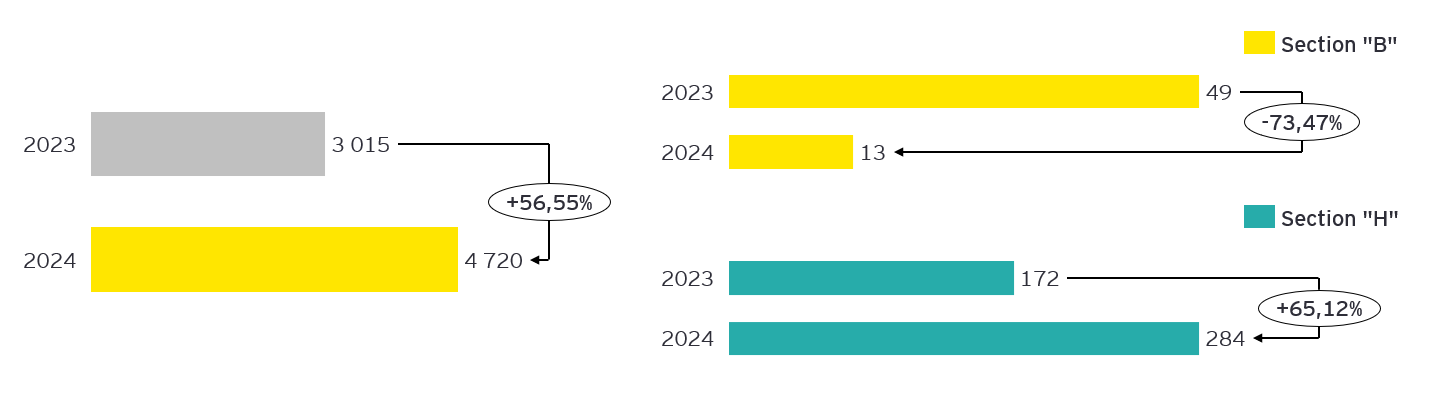 Number of permits issued for the employment of foreigners or stateless persons in all types of economic activity and by NACE type of economic activity in 2023 and 2024
As of 2024, 44 permits for the employment of foreigners and stateless persons were in force in the material reporting companies, of which 4 permits were issued during the year.
In the period from 2020 to 2023, Ukrainian extractive companies continued to actively attract foreign specialists to meet the needs for qualified labour. In 2022, due to the full-scale russian invasion of Ukraine, the number of permits issued for the employment of foreigners decreased fourfold compared to 2021. Detailed information on the number of permits issued for the employment of foreigners and stateless persons in the mining industries during this period is provided below.
According to data provided by the State Employment Centre as part of the preparation of the EITI Report for 2023, the total number of permits issued for the employment of foreigners or stateless persons continued its downward trend and amounted to 3,015 permits, which is 22.93% less than the number of permits issued in 2022. At the same time, the number of special permits issued in 2023 for NACE Section B (extractive industry and quarry development) increased by 53.13%. Despite this, Section H (transport, warehousing) demonstrated a decrease of 34.60% compared to the previous period.
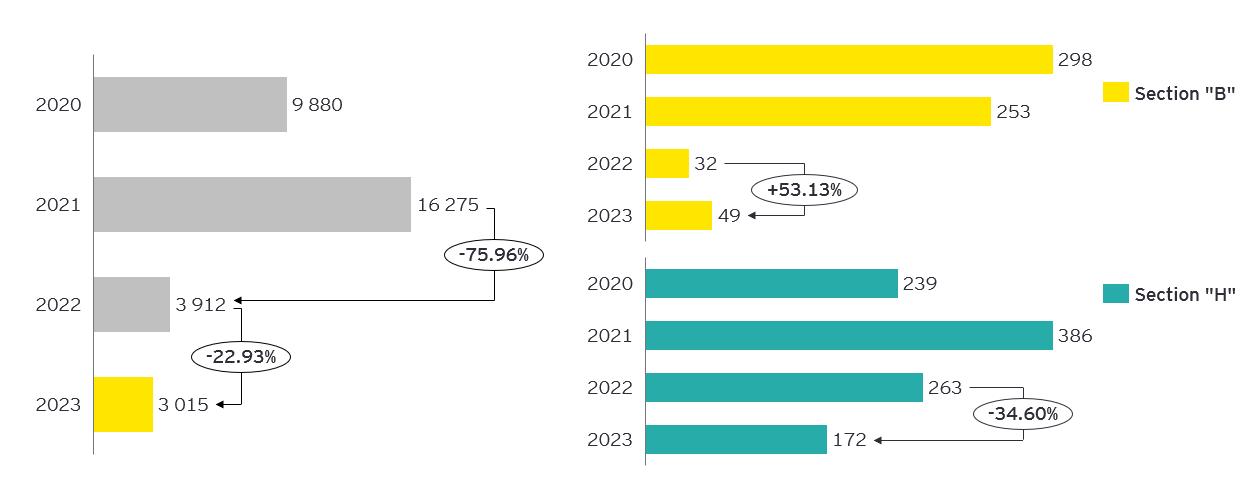 Number of permits issued for the employment of foreigners or stateless persons in all types of economic activity and by type of economic activity according to NACE in the period from 2020 to 2023
38 permits for the employment of foreigners and stateless persons were in force with the material reporting companies in 2023, nine of which were issued in that same year.
Gender pay gap
In accordance with requirement 6.3 A (IV) of the EITI Standard, companies are encouraged to disclose information on the gender pay gap. However, the current version of the EITI Law does not contain a direct requirement for reporting companies to make such disclosure. In view of this, the Independent Administrator made an additional request to the material reporting companies to disclose information on the gender pay gap.
The gender pay gap requires further attention from all stakeholders to identify possible disparities in certain extractive industries. Conducting such an analysis will allow to identify potential structural inequalities, contribute to a more inclusive development of the extractive sector and ensure compliance with international standards of transparency and sustainable development.